M5Stack Cardputer-Adv
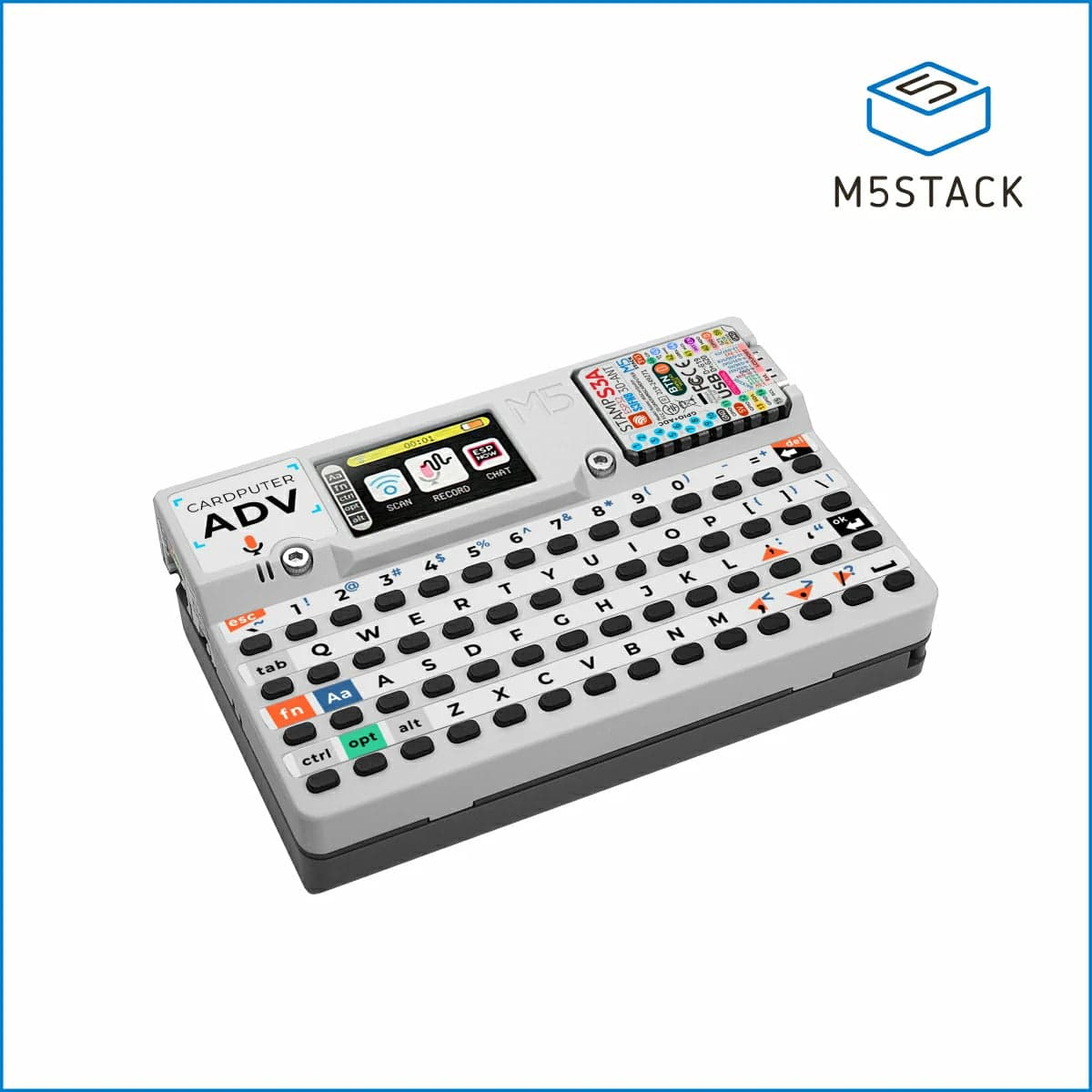
Credit-card-sized ESP32-S3 handheld computer with 56-key mechanical keyboard, 1.14" IPS display, BMI270 IMU, ES8311 audio codec, 1W speaker, MEMS microphone, IR transmitter, 1750mAh battery, Grove I2C port, and microSD slot.
$29.90
Tap any value to browse matching devices
Specifications
Components
Espressif ESP32-S3FN8 dual-core Xtensa LX7 at 240MHz with 8MB flash, WiFi 802.11 b/g/n, BLE 5.0, and RISC-V ULP co-processor.
Sitronix ST7789V2 TFT display controller driving the 1.14-inch 240×135 IPS LCD.
Everest Semiconductor ES8311 low-power mono audio codec with ADC and DAC for microphone input and headphone/speaker output.
Novosense NS4150B mono Class-D audio amplifier driving the built-in 1W speaker.
Bosch BMI270 ultra-low-power 6-axis inertial measurement unit with accelerometer and gyroscope for motion sensing.
Bus Interfaces
Overview
The M5Stack Cardputer-Adv is a compact, credit-card-sized programmable handheld computer built around the ESP32-S3FN8 dual-core Xtensa LX7 processor running at up to 240MHz with 512KB SRAM and 8MB flash. It is the advanced revision of the original Cardputer, featuring significant upgrades including a larger 1750mAh battery, improved 2.4GHz 3D antenna, ES8311 audio codec with 3.5mm headphone jack, BMI270 6-axis IMU, and reduced keyboard actuation force (160gf vs 260gf).
The 1.14-inch IPS LCD (240×135, ST7789V2 driver) and 56-key mechanical keyboard (4×14 matrix) provide a usable terminal-like interface in a pocket-friendly 84×54×20mm form factor. Audio capabilities include a high-SNR MEMS microphone, ES8311 codec, NS4150B Class-D amplifier driving a 1W speaker, and a 3.5mm headphone output. An IR transmitter enables remote control applications.
Connectivity includes 2.4GHz WiFi 4 (802.11 b/g/n) and Bluetooth 5.0 BLE with Mesh support. Expansion options include a Grove I2C port (5V), a 14-pin 2.54mm expansion bus, microSD card slot, and USB-C (OTG + Serial/JTAG). The built-in magnet and LEGO-compatible mounting holes allow flexible integration.
The Cardputer-Adv is fully programmable with Arduino IDE, ESP-IDF, UIFlow2, and PlatformIO. Its compact form factor, keyboard input, and rich peripheral set make it popular for portable terminals, IoT prototyping, security research, RF hacking tools, and handheld gaming.
Use Cases
8IoT Prototyping
General-purpose IoT development board suitable for rapid prototyping of connected devices, sensor nodes, and wireless applications.
Portable Terminal
Handheld computing device with keyboard and display for field use and on-the-go interaction.
Security Research
Hardware and wireless security research, vulnerability analysis, and penetration testing.
rf-hacking
Handheld Gaming
Portable handheld gaming device applications — running custom games, emulators, or interactive demos on a self-contained board with display and controls.
Remote Control
IR or RF-based remote control devices for appliances, TVs, air conditioners, and home electronics.
audio-projects
Education
Teaching programming, electronics, and computer science concepts. Popular in schools, universities, and coding bootcamps.
Where to Buy
Explore more of the directory — popular use cases, firmware, and specs to browse next.