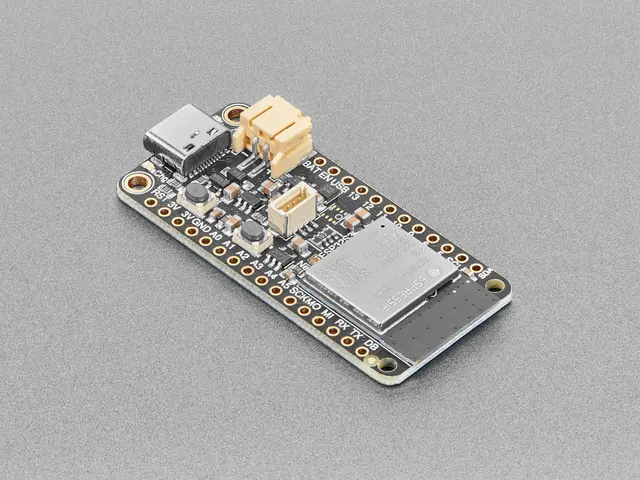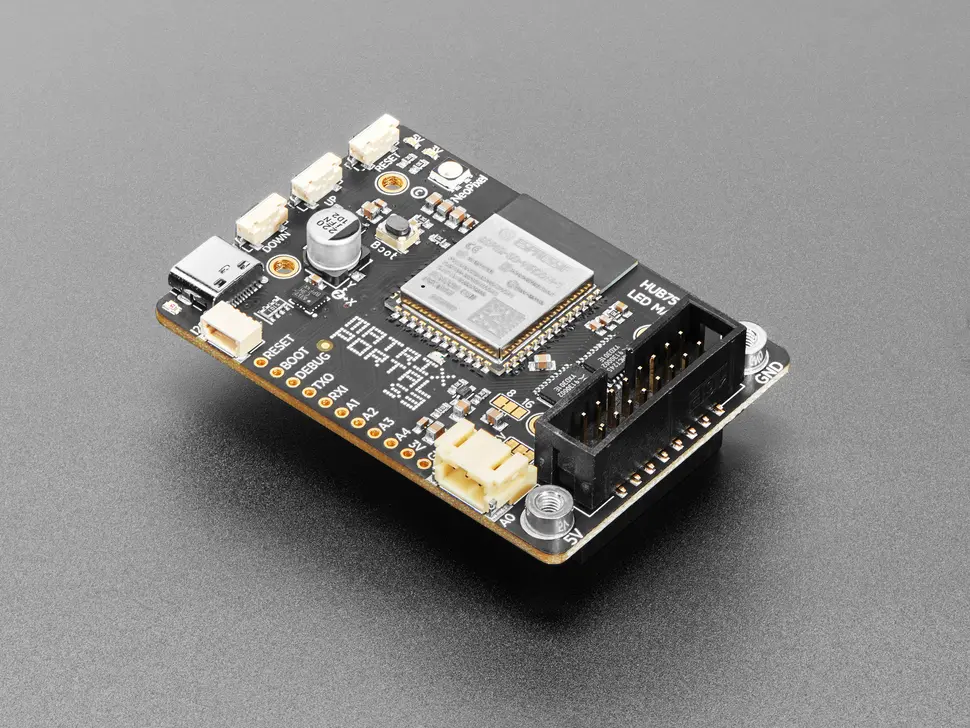
Adafruit Matrix Portal S3
ESP32-S3 board designed to drive HUB75 LED matrix panels directly, with built-in WiFi, BLE 5.0, native USB, STEMMA QT connector, and two user buttons — ideal for dynamic digital signage and LED art displays.
$19.95
Tap any value to browse matching devices
Specifications
Components
ESP32-S3 module with single-core Xtensa LX7 @ 240MHz, 8MB flash, 2MB PSRAM, native USB OTG, WiFi and BLE 5.0
Bus Interfaces
GPIO Map
The Adafruit Matrix Portal S3 is a purpose-built controller for HUB75 RGB LED matrix panels, combining an ESP32-S3 microcontroller with direct hardware connections for driving 64×32 or similar HUB75 panels without any additional wiring. The board handles all the row/column signal routing internally, leaving you free to focus on what to display.
Powered by the ESP32-S3 running at 240MHz with 8MB flash and 2MB PSRAM, the Matrix Portal S3 brings WiFi 802.11 b/g/n and BLE 5.0 connectivity so your display can pull live data from the internet — weather, scores, stock prices, transit arrivals, or any web API. Native USB-C enables CircuitPython drag-and-drop programming and CDC serial without a separate UART bridge chip.
On the front panel you get two user buttons (Up and Down) for local interaction, a STEMMA QT / Qwiic I2C port for attaching sensors or other peripherals without soldering, and a UART header for debugging. CircuitPython with the built-in protomatter library makes it straightforward to get colorful animations running in minutes, while Arduino and ESP-IDF are also supported for lower-level control.
Use Cases
4Digital Signage
Driving displays for advertising, information kiosks, or menu boards with 4K video and dynamic content.
LED Matrix Display
Boards purpose-built for driving RGB LED matrix panels for signs, art installations, and information displays.
Smart Home
Home automation devices for controlling lighting, climate, security, and appliances.
IoT
Internet of Things applications including connected sensors, actuators, and smart devices that communicate over WiFi, BLE, LoRa, or other wireless protocols.
Resources
Where to Buy
Explore more of the directory — popular use cases, firmware, and specs to browse next.