LuckFox Core3506
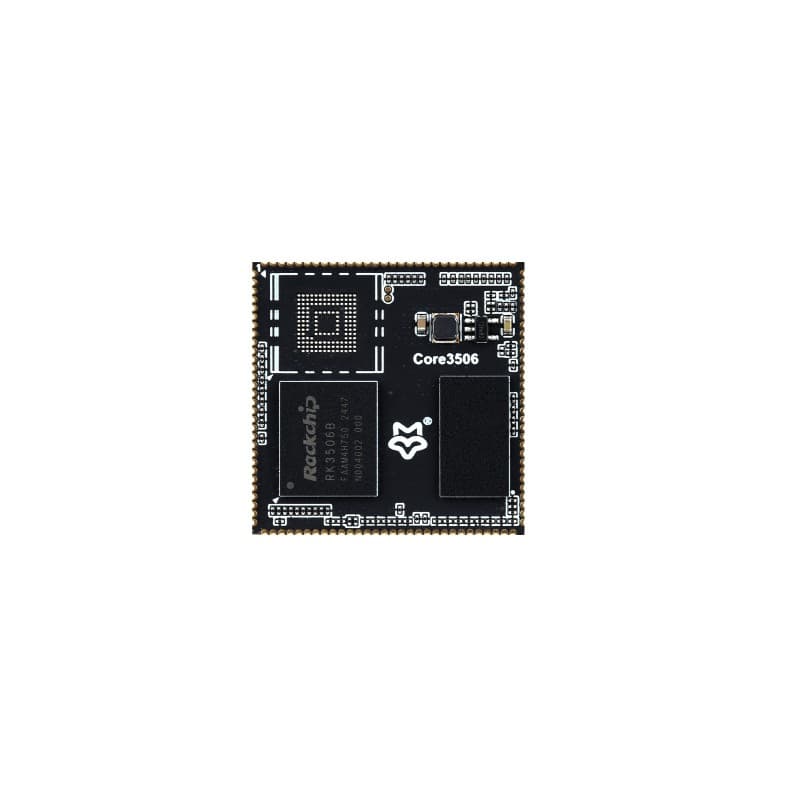
Tiny 32x32mm Rockchip RK3506B core module with tri-core ARM Cortex-A7 + Cortex-M0, 512MB DDR3L, optional 8GB eMMC, dual 100M Ethernet RMII, MIPI DSI 2-lane, 4-ch ADC, CAN bus, and 120-pin castellated holes. Supports Linux, RTOS, and bare-metal via AMP.
$8.99
Tap any value to browse matching devices
Specifications
Components
Rockchip RK3506B 22nm SoC with 3x Cortex-A7 @ 1.2GHz + Cortex-M0, dual 100M Ethernet RMII, MIPI DSI, 2D graphics, AMP multi-system support.
Overview
The LuckFox Core3506 is an ultra-compact 32x32mm system-on-module built around the Rockchip RK3506B SoC, featuring a tri-core ARM Cortex-A7 processor at 1.2GHz with an ARM Cortex-M0 co-processor for real-time tasks. The 22nm process node delivers low power consumption while supporting Linux, RTOS, and bare-metal firmware simultaneously through the chip's AMP (Asynchronous Multi-Processing) architecture.
The module packs 512MB DDR3L RAM with optional 8GB eMMC storage, exposed through 120 castellated holes for soldering onto custom carrier boards. It provides 32 Rockchip Matrix IO pins that can be multiplexed to support UART, SPI, I2C, CAN, PWM, and I2S interfaces. Connectivity includes dual 10/100Mbps Ethernet RMII interfaces, two USB 2.0 OTG ports, and a 2-lane MIPI DSI output supporting displays up to 1280x1280 at 60fps. A 4-channel ADC and analog differential microphone input round out the peripheral set.
Designed as a building block for custom products, the Core3506 is ideal for industrial HMI panels, IoT gateways, intercom systems, and smart home terminals where developers need a capable Linux-ready compute core in a minimal footprint. The module simplifies hardware development by providing the complete compute subsystem -- CPU, RAM, storage, and power management -- in a solderable package.
Use Cases
3System-on-Module Integration
Core compute module designed for integration into custom carrier boards and products, simplifying hardware development.
Industrial Control
Controlling industrial equipment and processes with real-time I/O, CAN bus, and robust connectivity.
IoT
Internet of Things applications including connected sensors, actuators, and smart devices that communicate over WiFi, BLE, LoRa, or other wireless protocols.
Resources
Where to Buy
Explore more of the directory — popular use cases, firmware, and specs to browse next.