Arduino MKR1000
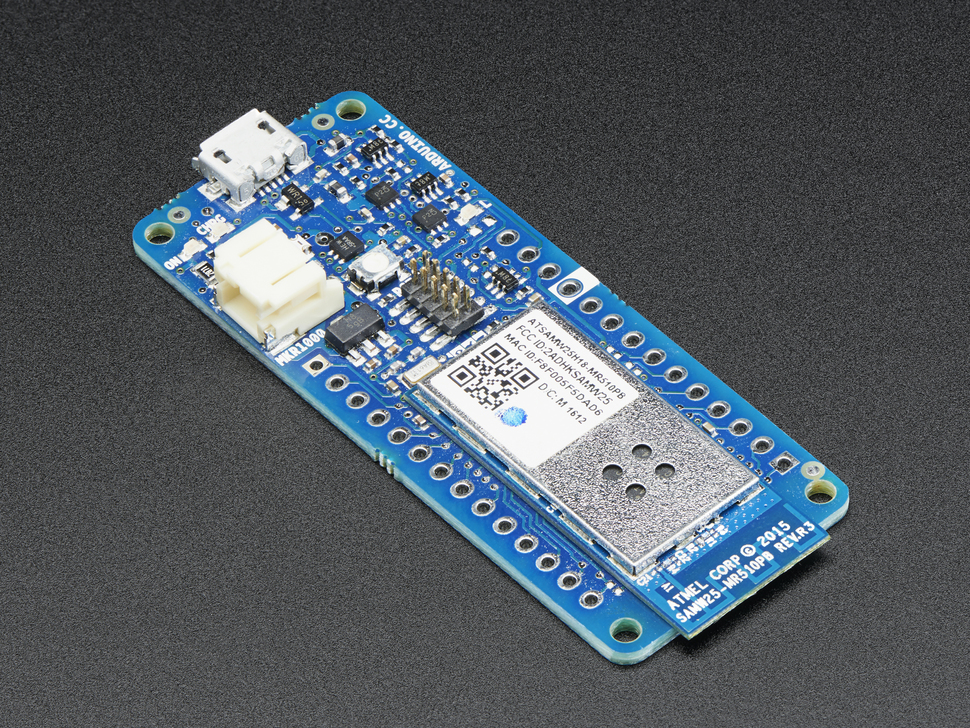
Compact Arduino board with SAMD21 ARM Cortex-M0+ and ATSAMW25 integrated WiFi (802.11 b/g/n) with cryptochip and SSL support. Built-in LiPo charger, 8 digital I/O, and 7 analog inputs in a slim 65mm form factor.
$44.95
Tap any value to browse matching devices
Specifications
Components
Integrated ATWINC1500 802.11b/g/n WiFi module with ATECC508A cryptochip for SSL/TLS and secure element.
Bus Interfaces
GPIO Map
Overview
The Arduino MKR1000 is a compact IoT development board that integrates the SAMD21 ARM Cortex-M0+ with the ATSAMW25 module — itself a combination of the ATWINC1500 WiFi radio and an ATECC508A cryptochip. This combination delivers 802.11 b/g/n WiFi with hardware-accelerated SSL/TLS and secure element support in a board measuring just 65 × 25 × 6 mm.
Running at 48 MHz with 256KB of flash and 32KB of SRAM, the MKR1000 offers considerably more compute power than 8-bit Arduino boards. The integrated cryptochip enables secure cloud connectivity and certificate-based authentication without additional hardware, making it a strong choice for IoT applications that need end-to-end security.
The MKR1000 supports 12 PWM pins, 7 analog inputs with configurable 8/10/12-bit ADC resolution, one DAC output, and standard I2C, SPI, and UART interfaces. A built-in LiPo charger with JST connector enables battery-powered wireless operation. The board operates at 3.3V logic, so care is needed when interfacing with 5V peripherals.
The MKR form factor became the basis for Arduino's IoT board family, and the MKR1000 was the first board in this series, designed for cloud-connected projects using the Arduino IoT Cloud or any standard MQTT/HTTPS service.
Use Cases
4IoT
Internet of Things applications including connected sensors, actuators, and smart devices that communicate over WiFi, BLE, LoRa, or other wireless protocols.
IoT Sensor Node
Compact wireless sensor node for collecting and transmitting environmental or industrial data.
Smart Home
Home automation devices for controlling lighting, climate, security, and appliances.
Prototyping
Rapid hardware prototyping and proof-of-concept development with breadboard-friendly form factors and accessible development environments.
Resources
Explore more of the directory — popular use cases, firmware, and specs to browse next.