Arduino Due
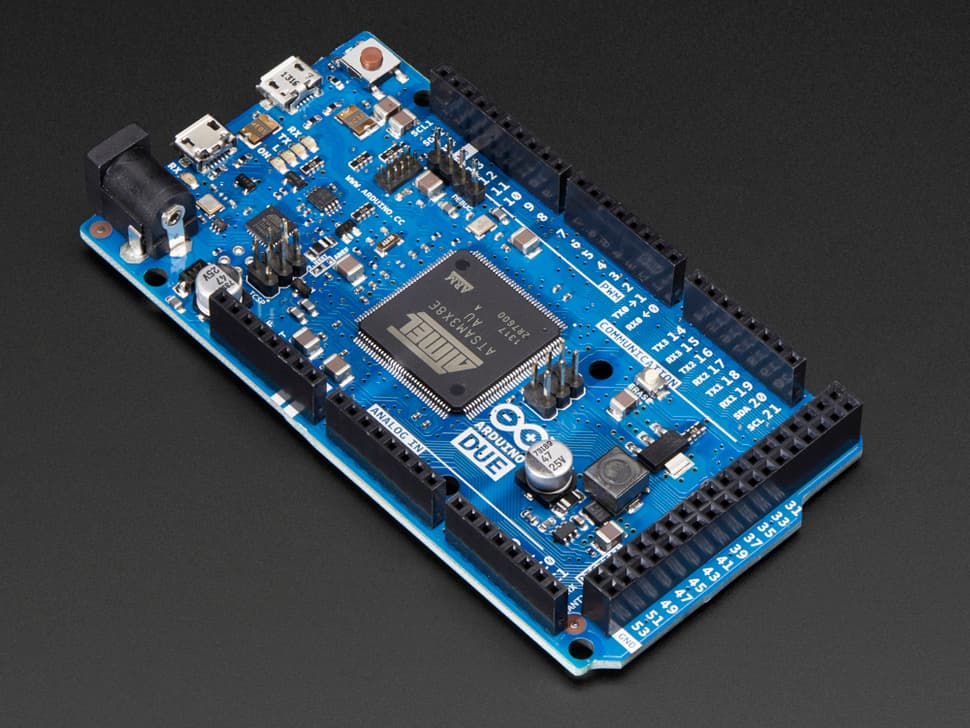
Arduino's first 32-bit ARM board based on the AT91SAM3X8E Cortex-M3 at 84 MHz with 512KB flash, 96KB SRAM, dual USB ports, 2 DACs, and 12 PWM channels in Mega form factor.
$47.50
Tap any value to browse matching devices
Specifications
Components
Atmel ARM Cortex-M3 at 84 MHz with 512KB flash, 96KB SRAM, USB OTG host, 2 DACs, CAN bus
Bus Interfaces
GPIO Map
Overview
The Arduino Due is the first Arduino board to feature a 32-bit ARM core, built around the Atmel AT91SAM3X8E ARM Cortex-M3 processor running at 84 MHz. It offers 512KB of flash and 96KB of SRAM (split across two 64KB and 32KB banks), providing substantially more computational power than 8-bit AVR-based boards while maintaining the Arduino Mega shield form factor.
The board includes two USB interfaces: a native USB port (for USB host, supporting mice, keyboards, cameras, and Android ADK) and a programming port (for sketch uploads and serial monitor). The Micro USB programming port simplifies development, while the native USB OTG port expands connectivity options for peripheral-interfacing projects.
Hardware highlights include two 12-bit DAC outputs for true analog audio or signal generation, 12 PWM channels, 4 hardware UARTs, 2 I2C buses, and a high-speed CAN interface. Operating at 3.3V, the Due is not 5V-tolerant on its I/O pins — a critical consideration when interfacing with legacy 5V shields or sensors.
The 12-bit ADC provides finer analog resolution than the 10-bit ADC on 8-bit Arduino boards, and the dedicated total DC output current of 130mA across all I/O lines requires attention in power-dense designs. The Due is particularly suited for audio processing, scientific instrumentation, drone control, and other computationally intensive applications.
Use Cases
5Audio
Audio playback, streaming, amplification, digital signal processing, and music projects.
Robotics
General robotics applications including mobile robots, robotic arms, drones, and automated systems.
scientific-instrumentation
Prototyping
Rapid hardware prototyping and proof-of-concept development with breadboard-friendly form factors and accessible development environments.
automation
Resources
Where to Buy

Explore more of the directory — popular use cases, firmware, and specs to browse next.