Arduino Zero
32-bit ARM Cortex-M0+ Arduino in UNO form factor with ATSAMD21G18 at 48 MHz, 256KB flash, 32KB SRAM, onboard EDBG debugger, dual USB ports, 12-bit ADC/DAC — designed for IoT, wearables, and robotics.
$54.95
Tap any value to browse matching devices
Specifications
Components
Microchip ARM Cortex-M0+ at 48 MHz, 256KB flash, 32KB SRAM, native USB, 12-bit ADC, 10-bit DAC, hardware EDBG debugger
Bus Interfaces
GPIO Map
Overview
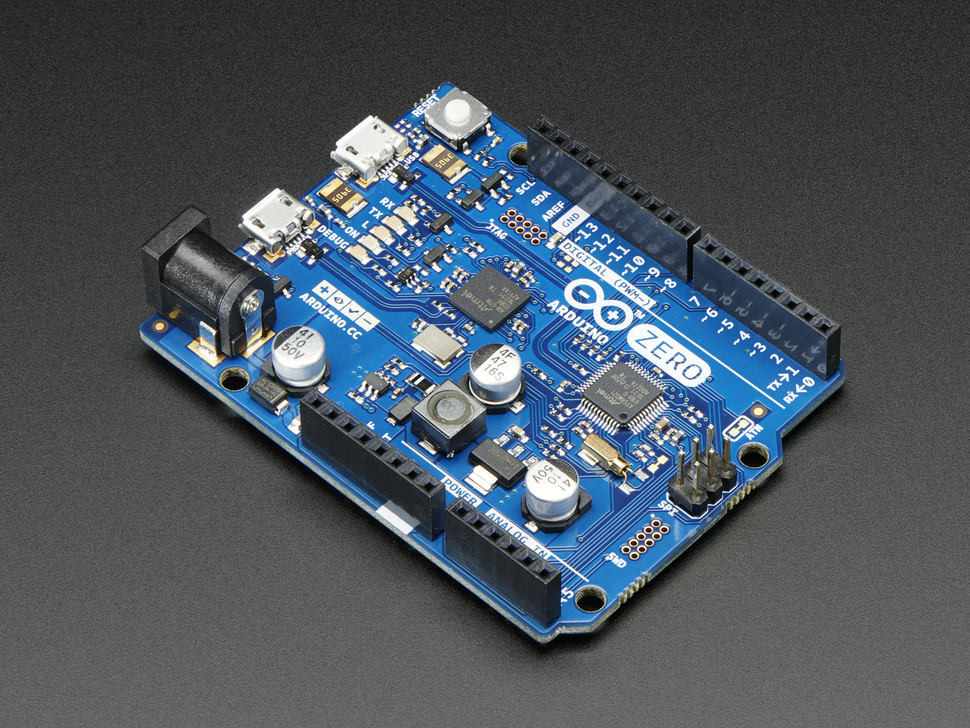
The Arduino Zero is a 32-bit Arduino board in the classic UNO/Leonardo form factor, built around the Atmel ATSAMD21G18 ARM Cortex-M0+ processor at 48 MHz. It marks Arduino's transition to 32-bit ARM architecture for the standard UNO pin layout, offering 256KB of flash and 32KB of SRAM — dramatically more than the 8-bit UNO — while maintaining shield compatibility.
A distinguishing feature of the Zero is its integrated Embedded Debugger (EDBG) provided by a second Atmel microcontroller. This enables full in-circuit debugging via the Arduino IDE without any additional hardware programmer, including breakpoints, memory inspection, and single-step execution — capabilities previously requiring external JTAG/SWD adapters.
The board includes two Micro USB ports: the Programming port (via EDBG, for normal sketch uploading and serial monitoring) and the Native port (direct ARM USB, for USB device emulation). The 12-bit ADC provides higher resolution analog measurements than 8-bit AVR boards, and a single 10-bit DAC output enables analog signal generation. All GPIO pins support PWM except pins 2 and 7.
Operating at 3.3V with 7mA maximum per I/O pin (versus 40mA on 5V AVR boards), the Zero requires careful design when interfacing with legacy 5V sensors or shields. The standard UNO form factor ensures broad shield compatibility, though 5V shields may require level shifting.
Use Cases
6IoT
Internet of Things applications including connected sensors, actuators, and smart devices that communicate over WiFi, BLE, LoRa, or other wireless protocols.
Robotics
General robotics applications including mobile robots, robotic arms, drones, and automated systems.
Wearable
Body-worn computing devices including smartwatches, fitness bands, and health monitors.
Education
Teaching programming, electronics, and computer science concepts. Popular in schools, universities, and coding bootcamps.
Prototyping
Rapid hardware prototyping and proof-of-concept development with breadboard-friendly form factors and accessible development environments.
automation
Resources
Where to Buy
Explore more of the directory — popular use cases, firmware, and specs to browse next.