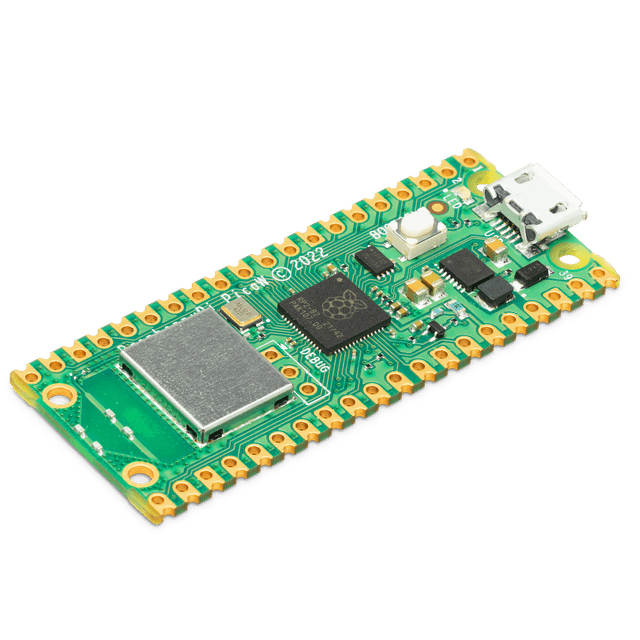
Blue Pill STM32F103C8T6
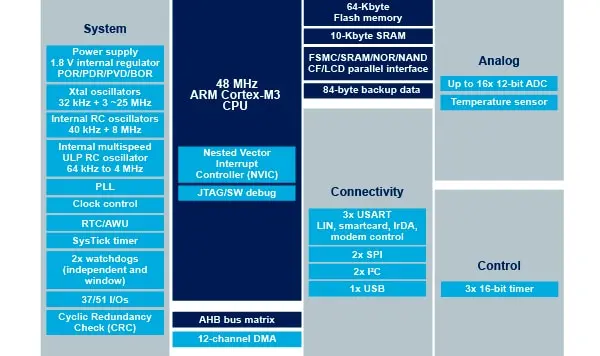
Popular low-cost development board based on the STM32F103C8T6 ARM Cortex-M3 microcontroller running at 72 MHz. Features 64 KB flash, 20 KB SRAM, and extensive peripheral support for embedded development.
$2.50
Tap any value to browse matching devices
Specifications
Components
STMicroelectronics 32-bit ARM Cortex-M3 MCU running at 72 MHz with 64 KB flash, 20 KB SRAM, and rich peripheral set including CAN, USB, and multiple timers.
External 8 MHz crystal oscillator providing the main clock source, multiplied by PLL to achieve the 72 MHz system clock.
Low-speed external crystal for the real-time clock (RTC) peripheral, enabling accurate timekeeping in low-power modes.
Bus Interfaces
Blue Pill STM32F103C8T6
The Blue Pill is one of the most widely used low-cost STM32 development boards in the embedded community. Based on the STM32F103C8T6 ARM Cortex-M3 microcontroller, it offers significantly more processing power and peripherals than 8-bit Arduino boards at a fraction of the cost.
Key Features
- STM32F103C8T6 ARM Cortex-M3 at 72 MHz
- 64 KB flash (many chips actually have 128 KB accessible)
- 20 KB SRAM
- 37 GPIO pins (most 5V tolerant)
- 2x SPI, 2x I2C, 3x UART, 1x CAN, 1x USB 2.0 Full Speed
- 2x 12-bit ADC (10 channels)
- 7x timers (including advanced motor control timer)
- SWD debug interface (via ST-Link)
- 8 MHz and 32.768 kHz crystals onboard
- Micro-USB connector
Programming Support
- STM32CubeIDE — ST's official IDE with HAL and LL drivers
- Arduino IDE — via STM32duino core (Roger's or official STM32 core)
- PlatformIO — with STM32 framework support
- MicroPython — community-supported STM32 port
- Rust — embedded Rust with stm32f1xx-hal crate
- Zephyr RTOS — supported target board
Debugging
The Blue Pill supports Serial Wire Debug (SWD) via an external ST-Link programmer. This enables full step-through debugging, breakpoints, and variable inspection — a significant advantage over serial-only debugging on Arduino boards.
Common Considerations
- Some Blue Pill clones use counterfeit STM32 chips (CKS32 or CS32) with slightly different behavior
- The onboard USB pull-up resistor (R10) often needs replacement (1.5k instead of 10k) for reliable USB connectivity
- Despite being a "64 KB" chip, most STM32F103C8T6 units have 128 KB of accessible flash
Use Cases
The Blue Pill excels in projects requiring real-time performance, multiple communication buses, or more GPIO than an Arduino Uno, all at a very low price point.
Use Cases
6Embedded Systems
Prototyping
Rapid hardware prototyping and proof-of-concept development with breadboard-friendly form factors and accessible development environments.
Motor Control
Industrial IoT
Build robust industrial IoT solutions using CAN bus, RS-485, Modbus, and wired Ethernet interfaces.
Education
Teaching programming, electronics, and computer science concepts. Popular in schools, universities, and coding bootcamps.
Robotics
General robotics applications including mobile robots, robotic arms, drones, and automated systems.
Resources
Where to Buy
Explore more of the directory — popular use cases, firmware, and specs to browse next.