Mesh Detect 2
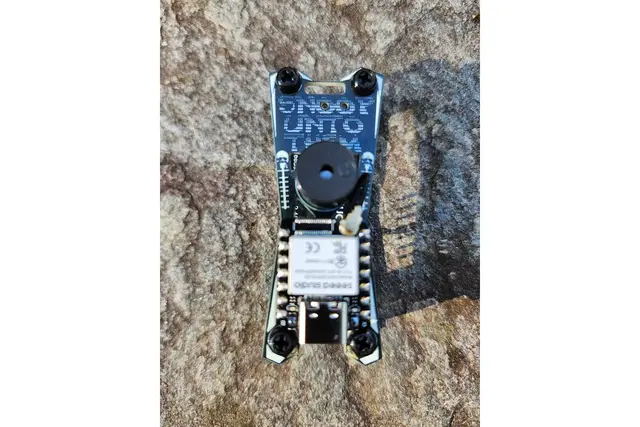
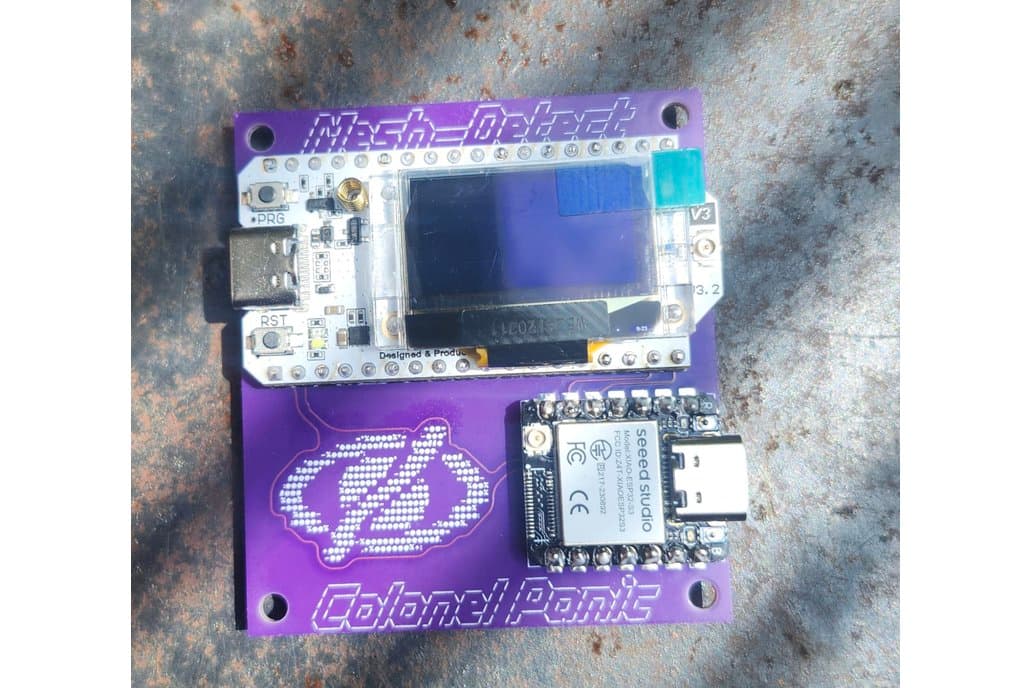
Open-source ESP32-S3 device that detects FAA Remote ID drone broadcasts and BLE devices, reporting alerts over the Meshtastic LoRa mesh network. Uses XIAO ESP32-S3 + Heltec V3.
$110.00
Tap any value to browse matching devices
Specifications
Components
Ultra-compact ESP32-S3 module handling WiFi and BLE scanning for Remote ID and OUI detection.
ESP32-S3 + SX1262 LoRa development board with 0.96" OLED display, providing mesh network connectivity via Meshtastic.
Bus Interfaces
The Mesh Detect 2 is a purpose-built wireless detection platform from Colonel Panic's Hack Shack that combines two ESP32-S3 boards into one compact device. The Seeedstudio XIAO ESP32-S3 handles WiFi and Bluetooth scanning duties — sniffing FAA Remote ID drone broadcasts and identifying nearby BLE devices by their OUI (Organizationally Unique Identifier) — while the Heltec WiFi LoRa 32 V3 relays detection alerts across a Meshtastic mesh network via its SX1262 LoRa radio. The result is a self-contained sensor node that can detect drones and unknown wireless devices in the field and instantly push notifications to every node on the mesh.
The device ships fully assembled and pre-flashed with Remote ID sniffing firmware, so it works out of the box when paired with any Meshtastic network. Three distinct firmware options are available: an OUI Sniffer that triggers alerts when specific Bluetooth manufacturer IDs appear, a Deepwoods Device Detection mode that baselines known WiFi and Bluetooth devices and flags newcomers, and the flagship Drone Remote ID module that captures operator location, drone coordinates, signal strength, and FAA ID data. A built-in web interface lets operators visualize detections and perform FAA ID lookups in real time.
Because the hardware design and firmware are fully open source on GitHub, makers can extend the platform with custom detection routines, add new alert types, or integrate it into larger security and monitoring deployments. A PCB-only variant is available at $20 for builders who want to source their own components. The Mesh Detect 2 is well suited for security researchers, penetration testers, drone awareness projects, and anyone who needs passive wireless surveillance over a decentralized off-grid network.
Use Cases
7Drone Detection
Detecting drones via WiFi and BLE Remote ID broadcasts (ASTM F3411) for airspace awareness and security.
BLE Device Detection
Scanning for and identifying Bluetooth Low Energy devices by their OUI (Organizationally Unique Identifier) signatures.
Airspace Monitoring
Monitoring airspace for drone activity using FAA Remote ID and wireless signal detection.
LoRa Mesh Networking
Building off-grid mesh communication networks using LoRa radio for text messaging, location sharing, and sensor data relay without cellular or internet infrastructure.
Security Research
Hardware and wireless security research, vulnerability analysis, and penetration testing.
Meshtastic Mesh
Off-grid mesh communication using Meshtastic firmware over LoRa radio.
Presence Detection
Room-level or zone-level presence and occupancy detection
Where to Buy
Available Software
3Drone Remote ID to Meshtastic
Open SourceCaptures drone Remote ID data via WiFi/BT and relays to Meshtastic mesh network with web UI.
OUI Sniffer
Open SourceBLE scanner that identifies specific Organizationally Unique Identifiers and generates mesh alerts.
Deepwoods Device Detection
Open SourceBaselines WiFi/BT devices and alerts on new, unknown devices appearing in range.
Explore more of the directory — popular use cases, firmware, and specs to browse next.