Waveshare RP2350-Matrix
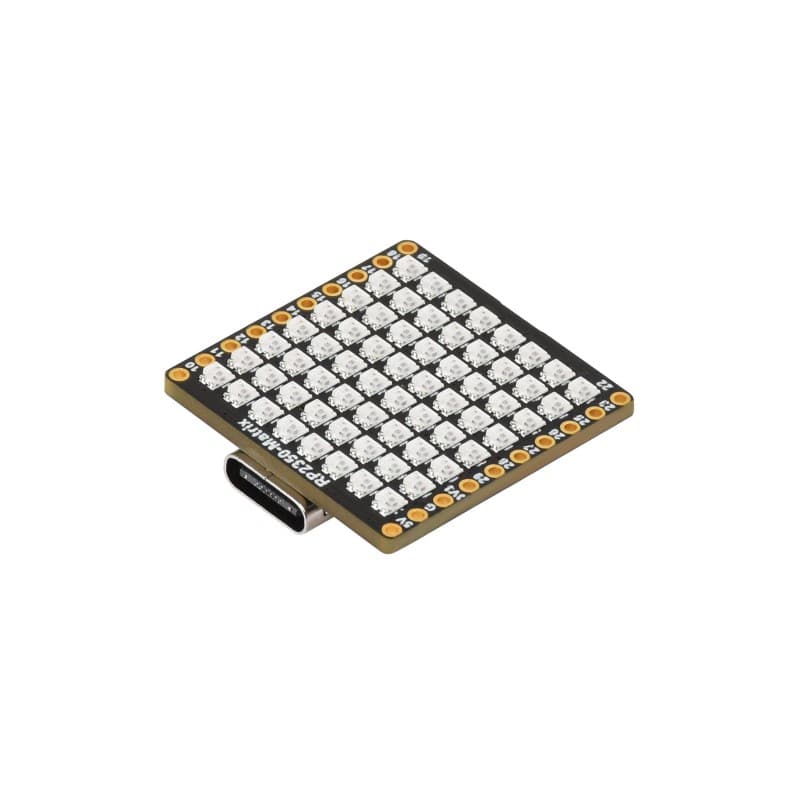
Compact RP2350A development board with an 8x8 WS2812 addressable RGB LED matrix, QMI8658 6-axis IMU (accelerometer + gyroscope), 16MB flash, 25 GPIO pins, HSTX interface, and USB-C for interactive LED displays and motion-controlled projects.
$9.99
Tap any value to browse matching devices
Specifications
Components
Raspberry Pi RP2350A dual-core microcontroller with switchable ARM Cortex-M33 and Hazard3 RISC-V cores at 150MHz, 520KB SRAM, 30 GPIO, HSTX, and 12 PIO state machines.
64 WS2812 addressable RGB LEDs arranged in an 8x8 matrix grid, driven by single-wire protocol from a GPIO pin, with DOUT for daisy-chaining additional LEDs.
QST QMI8658 6-axis inertial measurement unit with 3-axis accelerometer and 3-axis gyroscope, connected via I2C for motion sensing, gesture detection, and orientation tracking.
Microne ME6217C33M5G low dropout regulator providing stable 3.3V output with up to 800mA current for the MCU and peripherals.
GPIO Map
Overview
The Waveshare RP2350-Matrix is a compact development board that pairs the Raspberry Pi RP2350A dual-architecture microcontroller with an 8x8 WS2812 addressable RGB LED matrix and a QMI8658 6-axis IMU (3-axis accelerometer + 3-axis gyroscope). This combination enables interactive motion-controlled LED displays, simple pixel games, and visual notification systems out of the box.
The board runs on the RP2350A with switchable dual ARM Cortex-M33 or dual Hazard3 RISC-V cores at 150MHz, backed by 520KB SRAM and 16MB flash. The 64-pixel RGB LED matrix draws up to 900mA at full brightness, so a power adapter above 1A is recommended for maximum brightness operation. A DOUT pin allows chaining additional WS2812 LED strips or matrices for extended displays.
With 25 exposed GPIO pins featuring 2x UART, 2x SPI, 2x I2C, 4 ADC channels, 16 PWM channels, HSTX, and 12 PIO state machines, the board retains full prototyping flexibility despite the integrated peripherals. Included demo code provides colorful gradient animations, an IMU-controlled ball game, and temperature-based color control. Programming is supported via MicroPython, Arduino, and C/C++ Pico SDK.
Use Cases
3LED Matrix Display
Boards purpose-built for driving RGB LED matrix panels for signs, art installations, and information displays.
Prototyping
Rapid hardware prototyping and proof-of-concept development with breadboard-friendly form factors and accessible development environments.
IoT
Internet of Things applications including connected sensors, actuators, and smart devices that communicate over WiFi, BLE, LoRa, or other wireless protocols.
Resources
Where to Buy
Explore more of the directory — popular use cases, firmware, and specs to browse next.