Waveshare RP2350-One
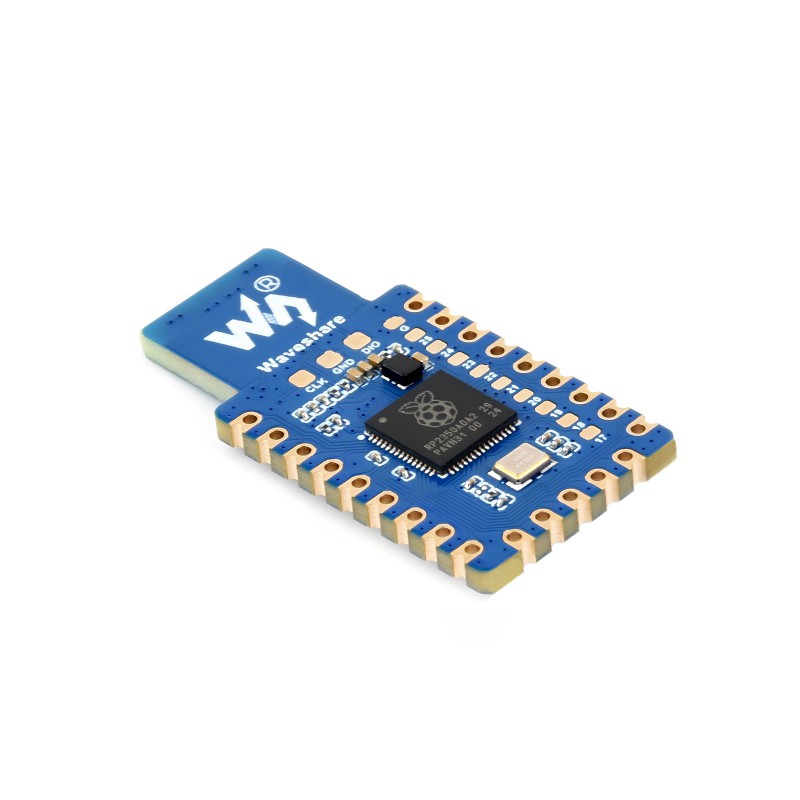
Ultra-compact USB-A plug-and-play development board with the Raspberry Pi RP2350A dual-architecture MCU, 4MB flash, WS2812 RGB LED, castellated module design, and 29 GPIO pins in a tiny 18 x 25.5mm form factor.
$4.99
Tap any value to browse matching devices
Specifications
Components
Raspberry Pi RP2350A dual-core microcontroller with switchable ARM Cortex-M33 and Hazard3 RISC-V cores at 150MHz, 520KB SRAM, 30 GPIO, 12 PIO state machines, and TrustZone security.
WS2812 addressable RGB LED on GP16 providing programmable status indication and visual feedback via single-wire protocol.
Richtek RT9013-33GB 500mA LDO voltage regulator providing stable 3.3V power from the 5V USB supply.
Winbond W25Q32JVSSIQ 4MB serial NOR flash memory storing firmware and user data via SPI/Quad-SPI interface.
GPIO Map
Overview
The Waveshare RP2350-One is an ultra-compact development board built around the Raspberry Pi RP2350A microcontroller, featuring a built-in PCB USB-A male plug for true plug-and-play operation without any cables. Its dual-architecture design lets developers switch between dual ARM Cortex-M33 cores and dual Hazard3 RISC-V cores at runtime.
The board exposes 29 multi-function GPIO pins (20 via edge castellated pads, the rest via solder points on the back), with support for 2x UART, 2x SPI, 2x I2C, 4 ADC channels, 16 PWM channels, and 12 PIO state machines. An onboard WS2812 addressable RGB LED on GP16 provides visual feedback for projects.
At just 18 x 25.5mm and 6 grams, the RP2350-One is designed for embedded applications where space is at a premium. The castellated module edges allow direct SMD soldering onto carrier boards, making it ideal for USB HID devices, compact IoT nodes, and space-constrained prototypes. Programming is supported via MicroPython, CircuitPython, Arduino (arduino-pico core), C/C++ Pico SDK, and drag-and-drop UF2 flashing.
Use Cases
3USB HID Device
Implementing a USB Human Interface Device such as a keyboard, mouse, game controller, or MIDI device using native USB support.
Prototyping
Rapid hardware prototyping and proof-of-concept development with breadboard-friendly form factors and accessible development environments.
IoT
Internet of Things applications including connected sensors, actuators, and smart devices that communicate over WiFi, BLE, LoRa, or other wireless protocols.
Resources
Where to Buy
Explore more of the directory — popular use cases, firmware, and specs to browse next.