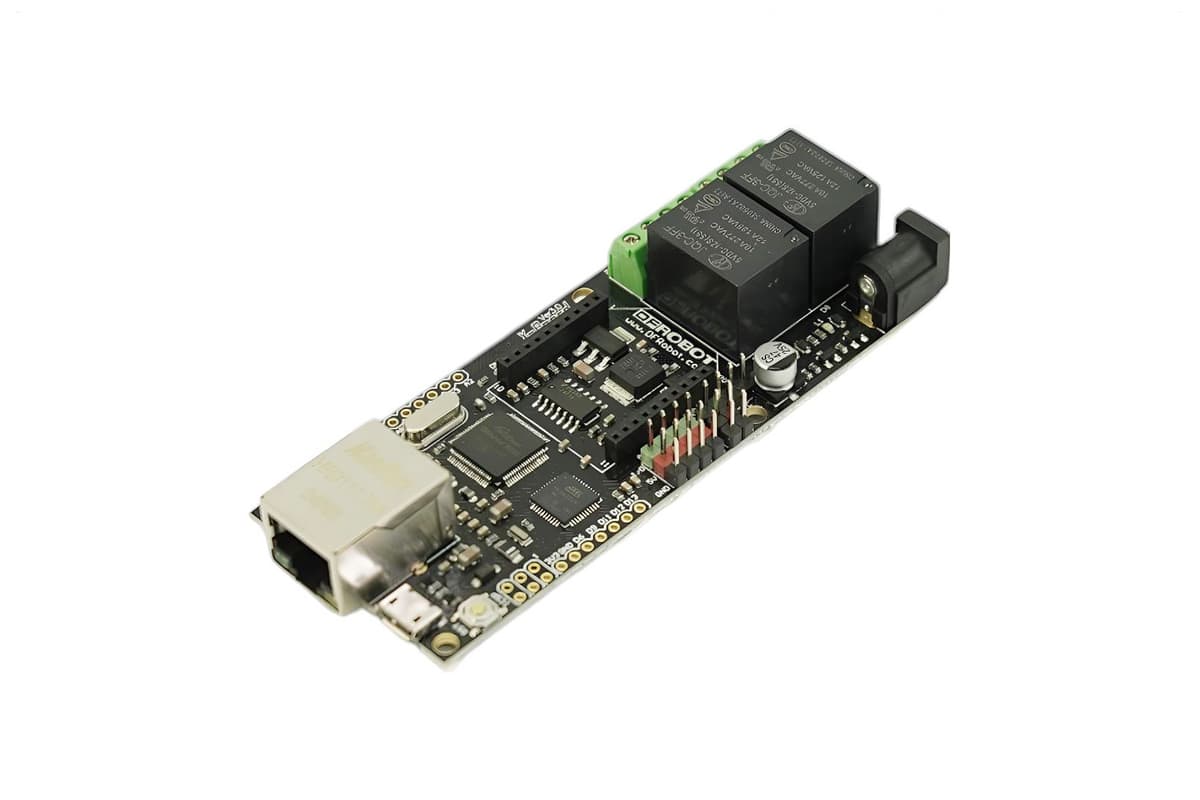
DFRobot Xboard Relay
Ethernet-controlled dual-relay board with ATmega32u4, WIZnet W5100 Ethernet, XBee socket, and two 10A relays for remote switching of AC/DC loads via web or MQTT, ideal for home automation.
$34.95
Tap any value to browse matching devices
Specifications
Components
Atmel ATmega32u4 8-bit AVR microcontroller at 16MHz with 32KB flash, 2.5KB SRAM, and native USB.
WIZnet W5100 Ethernet controller with hardwired TCP/IP stack, 10/100Mbps, supporting 4 simultaneous sockets.
Two onboard 10A SPDT relays rated for 150VAC/24VDC with UL rating, 10ms operating time.
GPIO Map
Overview
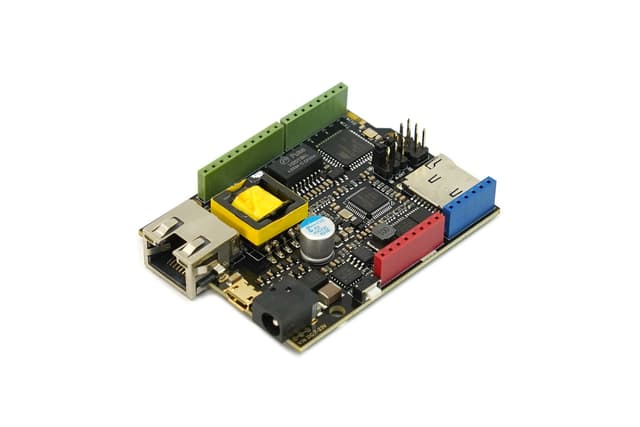
The DFRobot Xboard Relay is a compact, all-in-one Ethernet-controlled relay board that combines an ATmega32u4 microcontroller (Arduino Leonardo-compatible), a WIZnet W5100 Ethernet controller, and two built-in 10A relays on a single PCB. Designed for internet-based monitoring and control, it enables remote switching of AC/DC loads up to 150VAC/24VDC through a wired Ethernet connection.
Each relay is rated for 10A on the normally-open contact and 5A on the normally-closed contact, with a maximum switching power of 2770VA (AC) or 240W (DC). The relays carry UL ratings for 10A at 120VAC/277VAC, making them suitable for controlling household appliances, lighting, and HVAC equipment. The board also includes an XBee socket for optional wireless expansion.
Programming is done via Micro USB through the Arduino IDE using the standard Ethernet library and MQTT library support. Mobile control is available through the Xhouse iOS app and the Souliss Android app. With 2 analog inputs, 4 digital I/O pins, and I2C connectivity, the board can also read sensors for conditional automation — for example, turning on a heater when temperature drops below a threshold, all controlled and monitored over the local network.
Use Cases
3Where to Buy
Explore more of the directory — popular use cases, firmware, and specs to browse next.