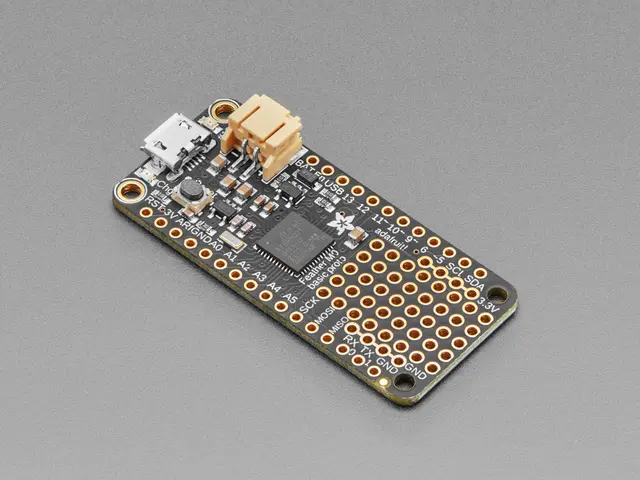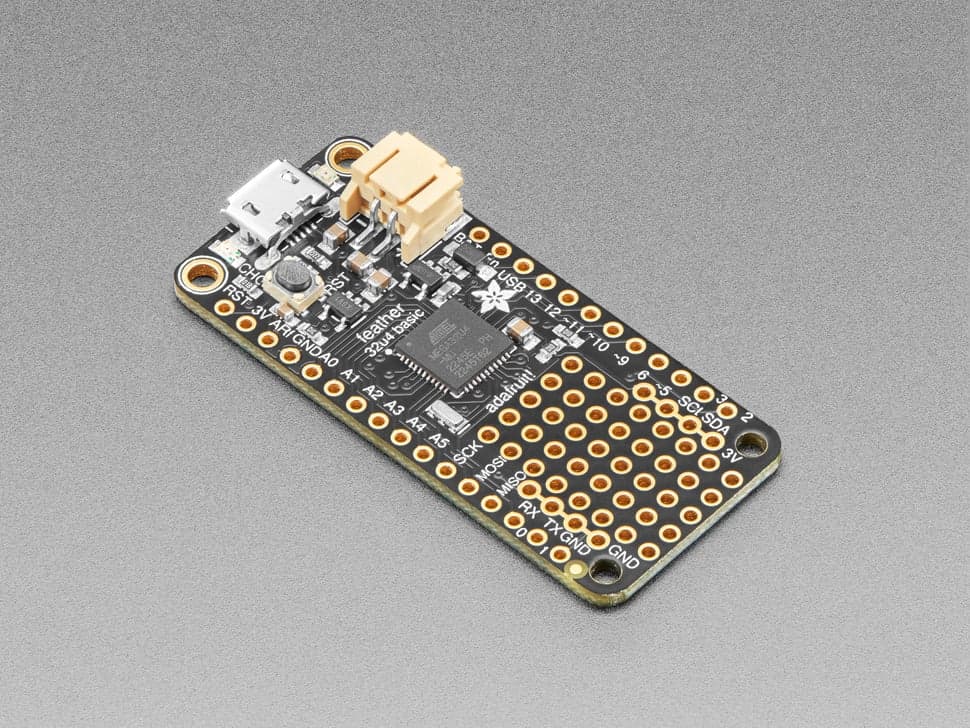
Adafruit Feather 32u4 Basic Proto
Feather-format ATmega32u4 board at 8 MHz, 3.3V with LiPo charging, native USB, onboard prototyping area, 20 GPIO, JST battery connector, and 100mA integrated charger — all in 51×23mm.
$19.95
Tap any value to browse matching devices
Specifications
Components
8-bit AVR with native USB at 8 MHz, 32KB flash, 2KB SRAM
Microchip MCP73831 100mA LiPo/LiIon charge management IC with automatic switchover
Bus Interfaces
GPIO Map
Overview
The Adafruit Feather 32u4 Basic Proto is part of Adafruit's Feather ecosystem — a family of thin, lightweight development boards designed for portable and battery-powered projects. Built around the ATmega32u4 at 8 MHz with 3.3V logic, it combines the Arduino Leonardo's native USB capabilities with an integrated LiPoly battery charger and a small prototyping area directly on the PCB.
The board provides 20 digital I/O pins (7 PWM-capable), 10 analog inputs (one dedicated to battery voltage monitoring), hardware Serial, I2C, and SPI, along with native USB support through the ATmega32u4's built-in USB controller. The integrated 100mA LiPoly charger automatically manages charging when USB power is connected, with automatic switchover between USB and battery power.
The 3.3V regulator provides up to 500mA peak output, and the JST connector accepts standard 3.7V lithium polymer batteries. At 51 × 23 × 8mm and just 4.8 grams, the board is optimized for space-constrained installations. Four mounting holes and a reset button are included.
The Feather 32u4 Basic Proto includes a small prototyping area with plated through-holes, enabling simple circuit additions without a separate breadboard. FeatherWing accessory boards can be stacked for additional functionality including displays, sensors, radios, and motor drivers, all sharing the standard Feather header footprint.
Use Cases
5portable
battery-powered
Wearable
Body-worn computing devices including smartwatches, fitness bands, and health monitors.
Prototyping
Rapid hardware prototyping and proof-of-concept development with breadboard-friendly form factors and accessible development environments.
IoT
Internet of Things applications including connected sensors, actuators, and smart devices that communicate over WiFi, BLE, LoRa, or other wireless protocols.
Where to Buy
Explore more of the directory — popular use cases, firmware, and specs to browse next.