Adafruit GEMMA M0
Coin-sized wearable microcontroller board with ATSAMD21E18 Cortex M0+ at 48MHz, 3 I/O sew pads, built-in RGB DotStar LED, and CircuitPython pre-installed. Designed for e-textiles and wearable projects.
$9.95
Tap any value to browse matching devices
Specifications
Components
32-bit ARM Cortex M0+ microcontroller at 48 MHz with 256 KB flash and 32 KB SRAM.
Bus Interfaces
GPIO Map
Overview
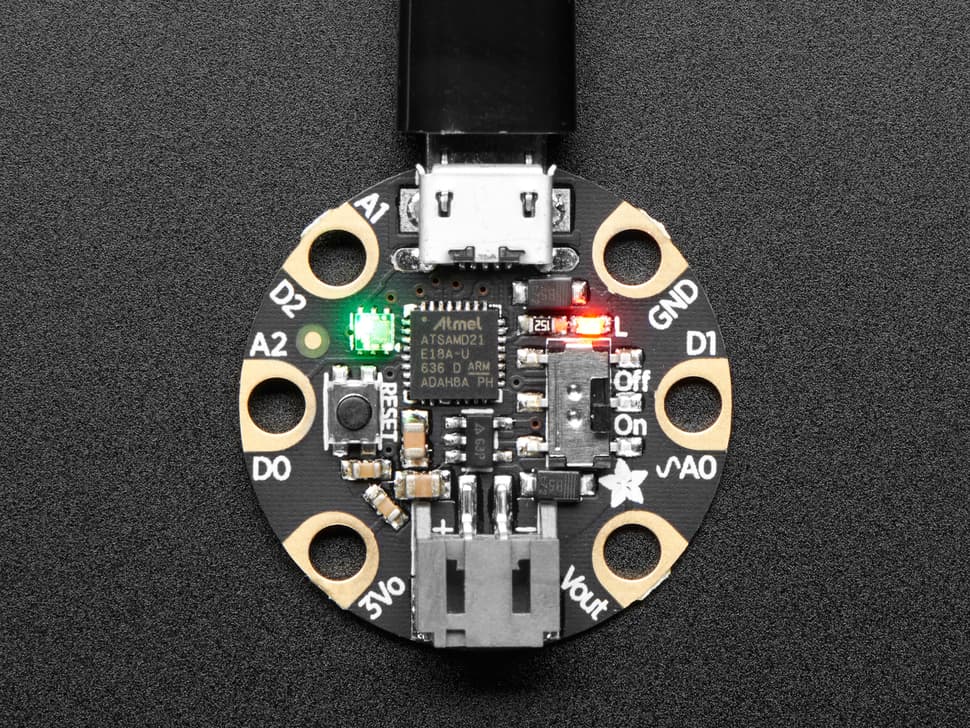
The Adafruit GEMMA M0 is a miniature, coin-shaped microcontroller board built around the ATSAMD21E18 ARM Cortex M0+ processor running at 48 MHz. Measuring just 27.95mm in diameter, it is purpose-designed for wearable electronics and e-textile applications where small size and sew-ability are essential.
The board ships with CircuitPython pre-loaded, making it beginner-friendly — simply connect via USB, open the drive that appears, and edit code.py to get started. It is also fully compatible with the Arduino IDE for users who prefer a traditional C++ workflow. A built-in RGB DotStar LED is accessible from any programming environment.
Three large sew pads provide I/O, power, and ground connections compatible with conductive thread, enabling projects like light-up costumes, smart accessories, and interactive textiles. The pads support analog input, digital I/O, PWM output, capacitive touch sensing, and one analog output (DAC). An on/off switch and JST battery connector make it easy to run from a coin cell or small LiPo pack.
Hardware peripherals include native I2C and UART, 256 KB of flash, and 32 KB of SRAM. Despite its small footprint, the GEMMA M0 is a capable platform for animations, sensor reading, and simple control tasks — all in a package small enough to sew onto a garment.
Use Cases
5Wearable
Body-worn computing devices including smartwatches, fitness bands, and health monitors.
E-Textiles
Electronic textiles integrate circuits and microcontrollers into fabric for smart clothing, wearable sensors, and interactive garments.
led-art
Education
Teaching programming, electronics, and computer science concepts. Popular in schools, universities, and coding bootcamps.
Prototyping
Rapid hardware prototyping and proof-of-concept development with breadboard-friendly form factors and accessible development environments.
Where to Buy
Explore more of the directory — popular use cases, firmware, and specs to browse next.