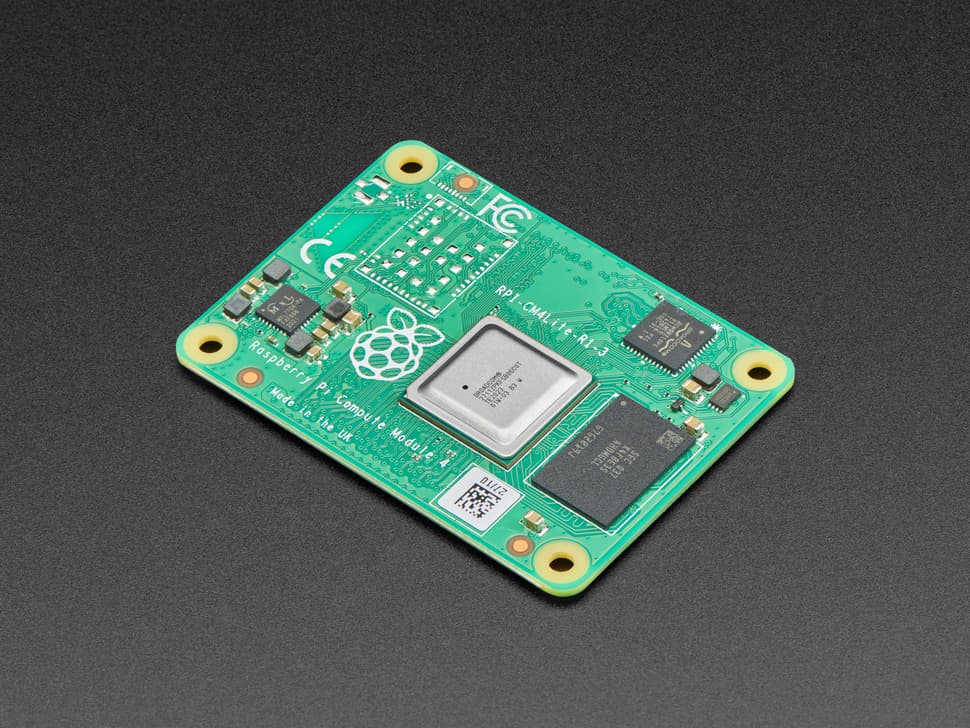
Raspberry Pi Compute Module 4
Industrial-grade embedded computer module with BCM2711 quad-core Cortex-A72 @ 1.5GHz, 1–8GB LPDDR4 RAM, optional 8–32GB eMMC and optional dual-band WiFi + Bluetooth 5.0. Available in 32 hardware variants on dual high-density connectors.
$25.00
Tap any value to browse matching devices
Specifications
Certifications
Components
Bus Interfaces
GPIO Map
Overview
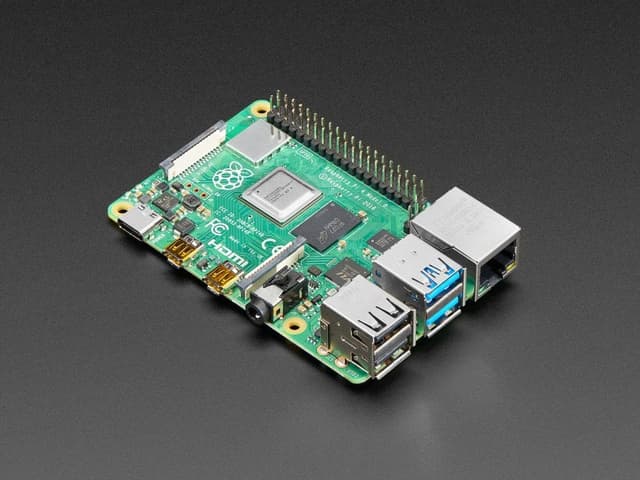
The Raspberry Pi Compute Module 4 (CM4) is Raspberry Pi's compact, embedded-computing module designed for integration into custom carrier boards and commercial products. Unlike the standard Pi 4 Model B, the CM4 exposes all its connectivity through two high-density 100-pin board-to-board connectors (Hirose DF40), placing I/O selection entirely in the hands of the carrier board designer. This makes it ideal for industrial controllers, kiosks, digital signage, network appliances, and embedded systems where a fixed-connector consumer board is impractical.
The CM4 is available in 32 hardware variants covering four RAM tiers (1GB, 2GB, 4GB, 8GB LPDDR4-3200), four eMMC storage tiers (Lite/no MMC, 8GB, 16GB, 32GB), and two wireless options (no wireless, or dual-band 802.11ac WiFi + Bluetooth 5.0 via onboard antenna). All variants share the same BCM2711 SoC — a quad-core ARM Cortex-A72 at 1.5GHz with VideoCore VI GPU — and the same 55×40mm form factor. RAM-only (Lite) variants use microSD via the carrier board; eMMC variants boot from the soldered flash.
The module exposes the full Raspberry Pi 4 peripheral set: 28 GPIO, up to 6 UART, 6 I2C, 5 SPI, dual HDMI, dual MIPI CSI camera, dual MIPI DSI display, PCIe Gen 2 ×1, USB 2.0, Gigabit Ethernet PHY (IEEE 1588 capable), and H.265/H.264 hardware video decode. The PCIe lane is a particularly notable addition over the Pi 4 Model B, enabling M.2 NVMe storage or other PCIe peripherals when used with an appropriate carrier board.
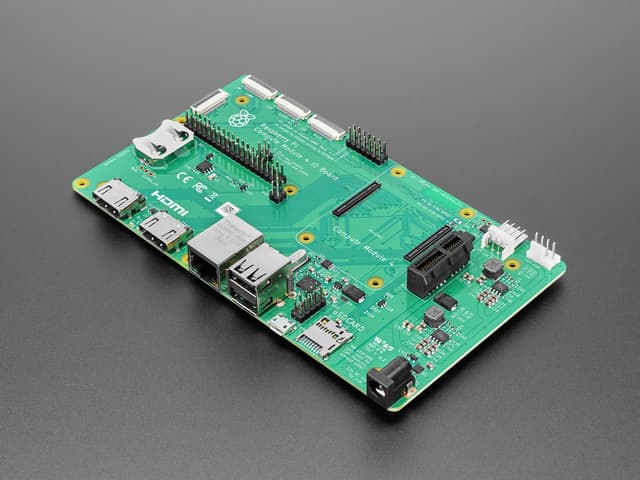
Raspber Pi publishes full KiCad design files for both the CM4 and the reference CM4 IO Board, allowing designers to build custom carrier boards validated against the official reference design. The module runs the complete Raspberry Pi OS software ecosystem and all compatible Linux distributions.
Use Cases
5IoT
Internet of Things applications including connected sensors, actuators, and smart devices that communicate over WiFi, BLE, LoRa, or other wireless protocols.
IoT Gateway
Acting as a local IoT gateway that aggregates data from sensors, runs MQTT broker, Node-RED, or Home Assistant, and bridges to the cloud.
Digital Signage
Driving displays for advertising, information kiosks, or menu boards with 4K video and dynamic content.
Industrial Automation
Boards designed or suitable for industrial control, automation, and embedded systems in harsh environments.
Smart Home
Home automation devices for controlling lighting, climate, security, and appliances.
Resources
Where to Buy
Explore more of the directory — popular use cases, firmware, and specs to browse next.