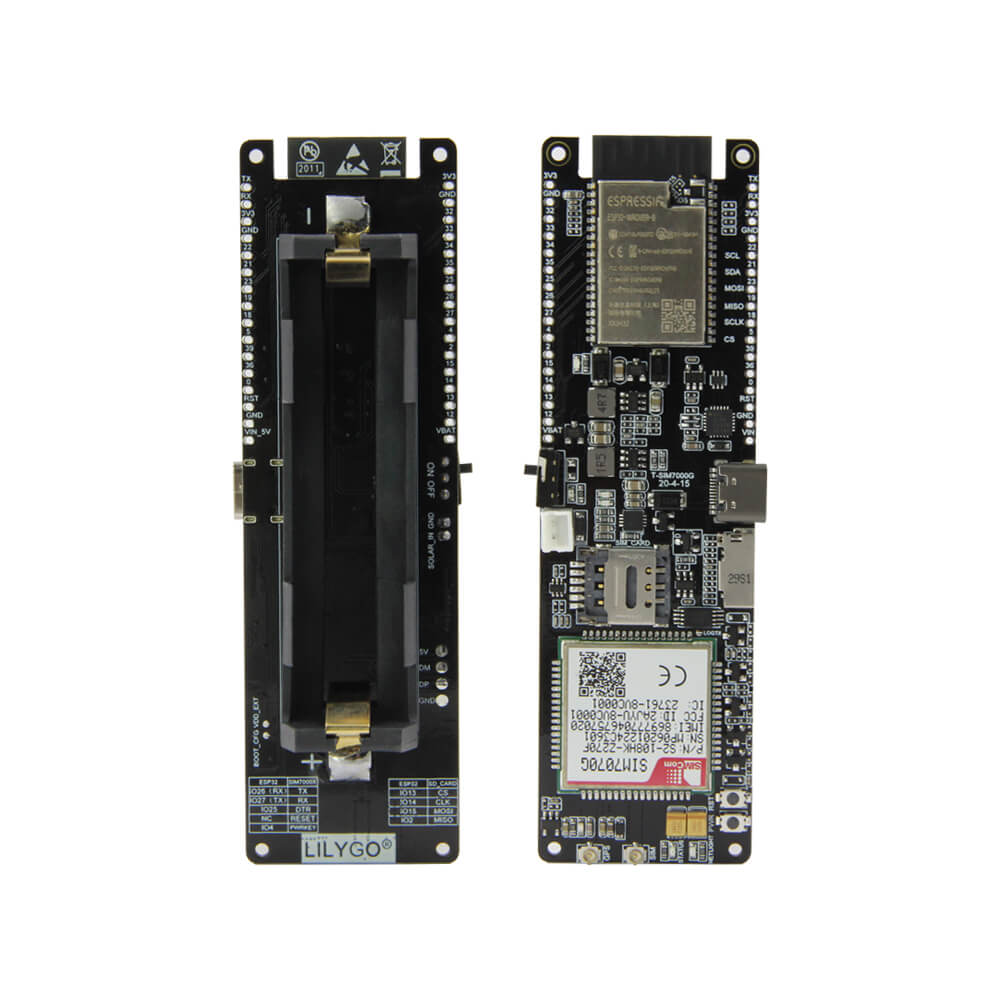
LILYGO T-SIM7070G
An ESP32-WROVER-E development board with integrated SIM7070G LTE Cat-M/NB-IoT/GPRS modem and GNSS, designed for ultra-low-power global cellular IoT deployments with solar charging support.
$26.59
Hardware Specifications
Connectivity
Components
Dual-core Xtensa LX6 at 240MHz with 520KB SRAM and 8MB PSRAM, integrated Wi-Fi and Bluetooth
Global multi-band LTE Cat-M/NB-IoT/GPRS/EDGE modem with integrated GNSS (GPS/Beidou/GLONASS)
USB to serial bridge chip for programming and serial communication
Resources


Where to Buy
Overview
The LILYGO T-SIM7070G is an ESP32-WROVER-E development board featuring the SIM7070G multi-band cellular modem, which supports LTE Cat-M, NB-IoT, GPRS, and EDGE protocols for global deployments. The integrated GNSS receiver supports GPS, Beidou, and GLONASS for multi-constellation positioning, making this a complete cellular tracker and IoT node platform.
The SIM7070G is a cost-optimized modem from SIMCom specifically designed for IoT applications requiring very low power consumption. LTE Cat-M and NB-IoT are LPWA (Low-Power Wide-Area) technologies that consume significantly less power than traditional LTE, enabling battery-operated deployments that can run for months or years on a single charge. The modem supports protocols including TCP/UDP, HTTP/HTTPS, FTP, TLS/DTLS, PING, LwM2M, CoAP, and MQTT directly from the modem without routing through the ESP32.
The ESP32-WROVER-E module provides 8MB PSRAM for large data buffers alongside 4MB Flash and the 240MHz dual-core processor. The board connects to the SIM7070G via UART and includes a solar charging input for off-grid energy harvesting. NanoSIM and microSD card slots are included, and both LTE and GPS antennas are provided in the box.
This board is ideal for environmental monitoring buoys, agricultural sensors, remote asset tracking, smart metering, and any IoT node that needs global cellular connectivity with minimal power consumption.
Firmware Compatibility
- Arduino: Fully supported. Use TinyGSM with the SIM7070G modem type for MQTT, HTTP, and TCP/UDP communication.
- ESP-IDF: Supported via direct AT command UART interface to the SIM7070G.
Flashing Guide
- Install the CH9102 driver from WCH's website.
- Connect via USB Type-C cable.
- In Arduino IDE, select "ESP32 Wrover Module" (enables 8MB PSRAM) and the correct COM port.
- Install TinyGSM library and configure for the SIM7070G modem type.
- Insert a nano SIM card that supports LTE Cat-M or NB-IoT.
- Connect the LTE antenna and GPS antenna before powering up.
- Refer to https://github.com/Xinyuan-LilyGO/T-SIM for examples and pinout documentation.
Related Products
ESP32This product page may contain errors. If you find any, please report them.