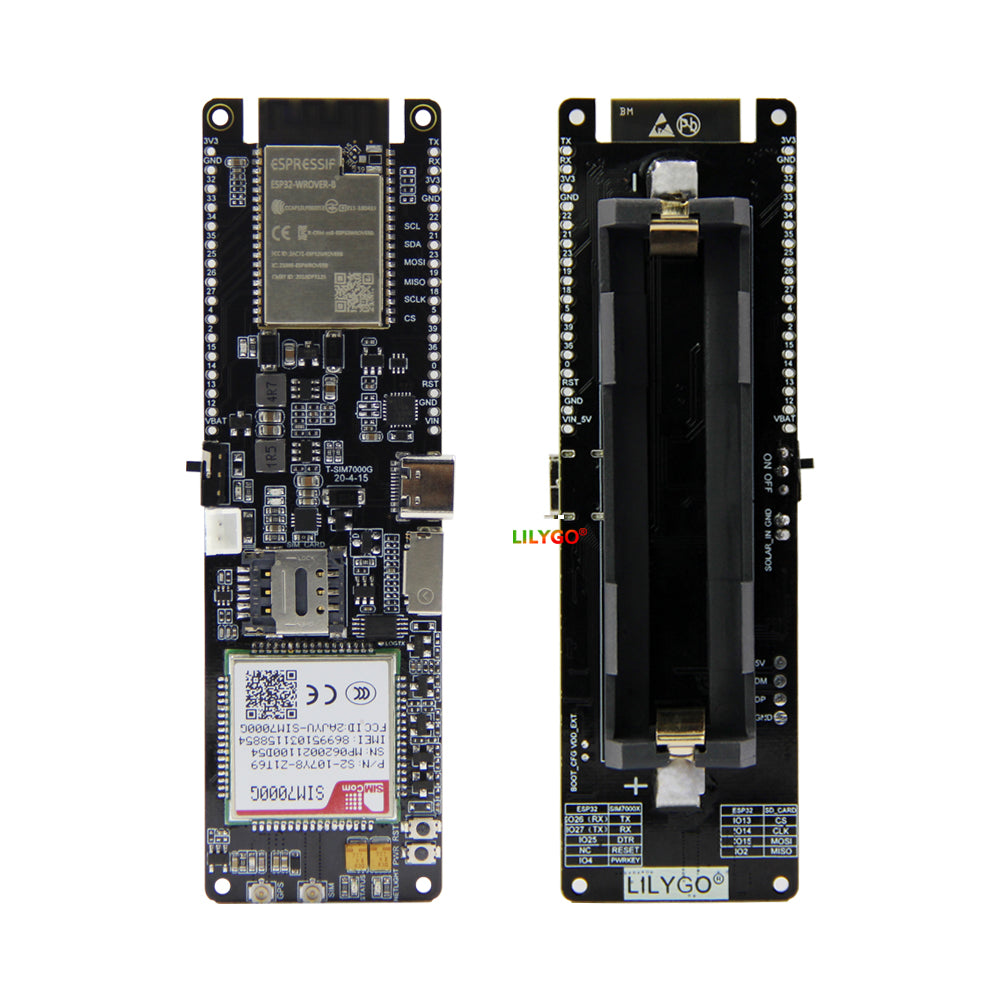
LILYGO T-SIM7000G
An ESP32 development board with integrated SIM7000G global LTE Cat-M/NB-IoT and GSM modem, GPS, and support for solar and 18650 battery power for remote IoT deployments worldwide.
$35.14
Hardware Specifications
Connectivity
Components
Dual-core Xtensa LX6 microprocessor at 240MHz with integrated Wi-Fi and Bluetooth
Global multi-band LTE Cat-M1/NB1 and GSM/GPRS/EDGE modem with integrated GPS
USB to serial bridge chip for programming
Resources


Where to Buy
Overview
The LILYGO T-SIM7000G is an ESP32-based development board built for global cellular IoT deployments. The integrated SIM7000G modem supports LTE Cat-M1 and NB-IoT (NB1) alongside legacy GSM/GPRS/EDGE, giving the device worldwide network coverage on a single hardware platform. The modem also integrates GPS functionality, enabling location-aware applications without a separate GPS module.
The board is designed for low-power IoT applications where devices need to send periodic data over cellular networks. LTE Cat-M and NB-IoT are specifically designed for IoT use cases: they offer lower power consumption than LTE Cat-4, better building penetration, and lower data rates suited to sensor telemetry, asset tracking, and smart metering.
Power flexibility is a key feature. The board accepts USB Type-C (5V), an 18650 Li-Ion battery via a standard holder, and a 2-pin JST 2.0mm solar charging input — making it suitable for off-grid deployments. The 8MB PSRAM ensures the ESP32 has ample memory for modem data buffers and local computation. A TF (microSD) card slot is included for local data logging.
This board uses the TinyGSM library ecosystem for modem communication, which provides a unified API for AT command interaction with the SIM7000G. It communicates with MQTT brokers, HTTP/HTTPS servers, and other TCP/IP services directly through the modem's data connection.
Firmware Compatibility
- Arduino: Fully supported. Use TinyGSM library for modem communication, and the standard ESP32 Arduino core for Wi-Fi and Bluetooth.
- ESP-IDF: Supported for advanced projects needing direct AT command control over the SIM7000G UART interface.
Flashing Guide
- Install the CH9102 USB-to-serial driver from WCH's website.
- Connect via USB Type-C cable.
- In Arduino IDE, select "ESP32 Wrover Module" (to enable PSRAM) and the correct COM port.
- Install the TinyGSM library (by Volodymyr Shymanskyy) and the ESP32 board support package.
- Insert a nano SIM card that supports LTE Cat-M or NB-IoT (check with your carrier).
- Connect the provided LTE antenna and GPS antenna before powering up.
- Upload your sketch. Refer to the GitHub repo at https://github.com/Xinyuan-LilyGO/LilyGo-Modem-Series for working examples.
Related Products
ESP32This product page may contain errors. If you find any, please report them.