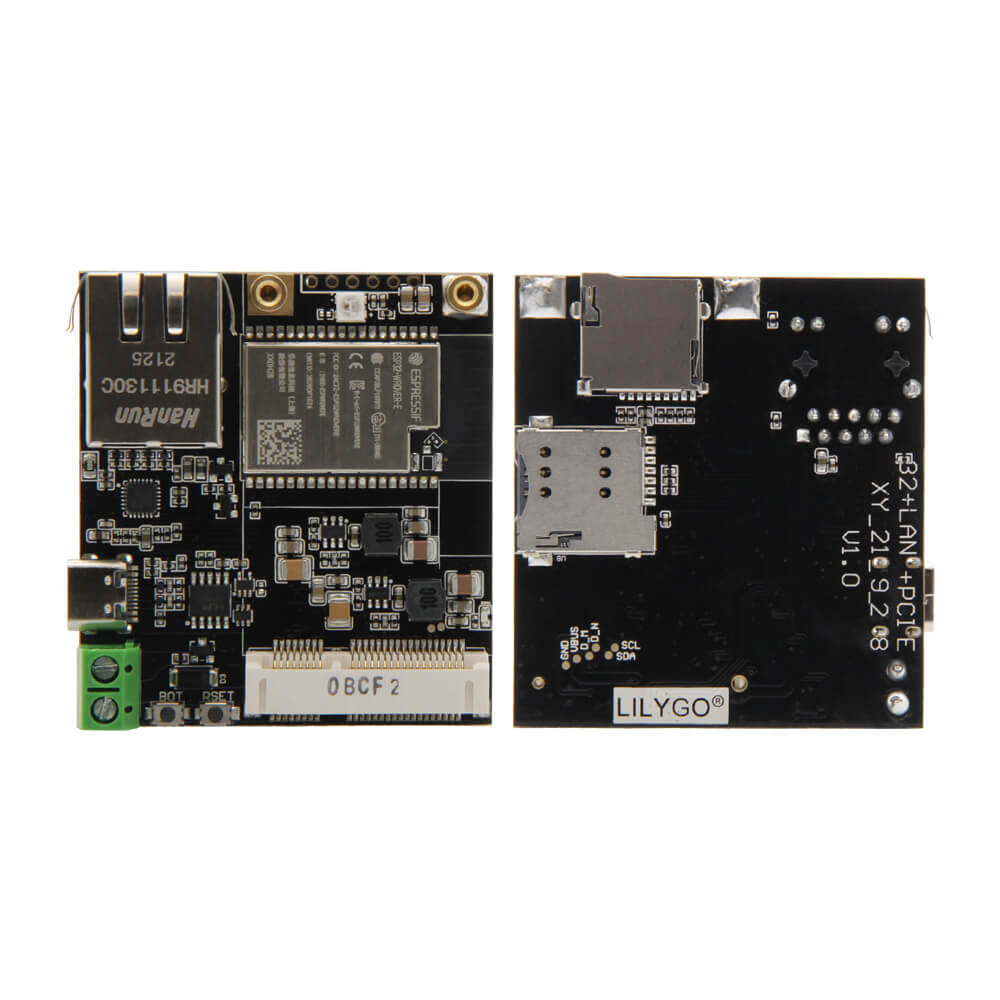
LILYGO T-Internet-COM
An ESP32 development board with LAN8720 wired Ethernet, M.2 slot for T-PCIE cellular modules, 16MB Flash, 8MB PSRAM, and WS2812 RGB LED for multi-connectivity industrial IoT gateways.
$13.30
Hardware Specifications
Connectivity
Components
Dual-core Xtensa LX6 at 240MHz with integrated Wi-Fi 802.11 b/g/n and Bluetooth 4.2 BLE
10/100Base-T Ethernet PHY transceiver with flexible power management
USB to serial bridge chip for programming
Addressable RGB LED on GPIO12 for status indication and visual feedback
Resources


Where to Buy
Overview
The LILYGO T-Internet-COM is a multi-connectivity ESP32 development board that serves as a versatile IoT gateway platform. It combines wired Ethernet (via LAN8720 PHY), Wi-Fi, Bluetooth, and an M.2 expansion slot for T-PCIE cellular modules, providing up to four simultaneous communication paths in a single board.
The ESP32 is paired with 16MB Flash and 8MB PSRAM, giving it significantly more resources than typical ESP32 boards. The standard peripheral interfaces (UART, SPI, I2C, CAN, I2S, SDIO) are all exposed, along with a NanoSIM and TF (microSD) card slot. A WS2812 addressable RGB LED on GPIO12 provides status indication. The board accepts a wide 5-12V DC input, making it flexible for both USB and industrial power supply connections.
The M.2 slot accepts T-PCIE series modules that support a wide range of cellular modems — including SIM7000G (LTE Cat-M/NB-IoT), SIM7600 (LTE Cat-4), A7670 (LTE Cat-1), and others — enabling cellular backhaul for the Ethernet LAN. The CH9102 USB chip handles programming via USB Type-C, and RST + BOOT buttons are provided for manual control.
This board is particularly well-suited for building multi-WAN IoT gateways, edge computing nodes with cellular failover, smart building controllers, and industrial automation applications where both wired and wireless connectivity redundancy is important.
Firmware Compatibility
- ESPHome: Supported with the
ethernetcomponent (LAN8720) and optional cellular modem integration. - Arduino: Supported via the ESP32 Ethernet library with LAN8720 configuration and WS2812 LED libraries.
- ESP-IDF: Supported with native Ethernet (RMII/LAN8720), PSRAM, and USB drivers.
Flashing Guide
- Install the CH9102 driver if needed.
- Connect via USB Type-C cable.
- In Arduino IDE, select "ESP32 Wrover Module" (to enable 8MB PSRAM) and the correct COM port.
- For Ethernet, use
ETH.begin()with LAN8720 PHY configuration. - For T-PCIE cellular: insert the module into the M.2 slot and use TinyGSM with the appropriate modem type.
- To control the WS2812 LED, use the FastLED or NeoPixel library addressing GPIO12.
- Refer to https://github.com/Xinyuan-LilyGO/T-Internet-COM for complete pinout diagrams and example code.
Related Products
ESP32This product page may contain errors. If you find any, please report them.