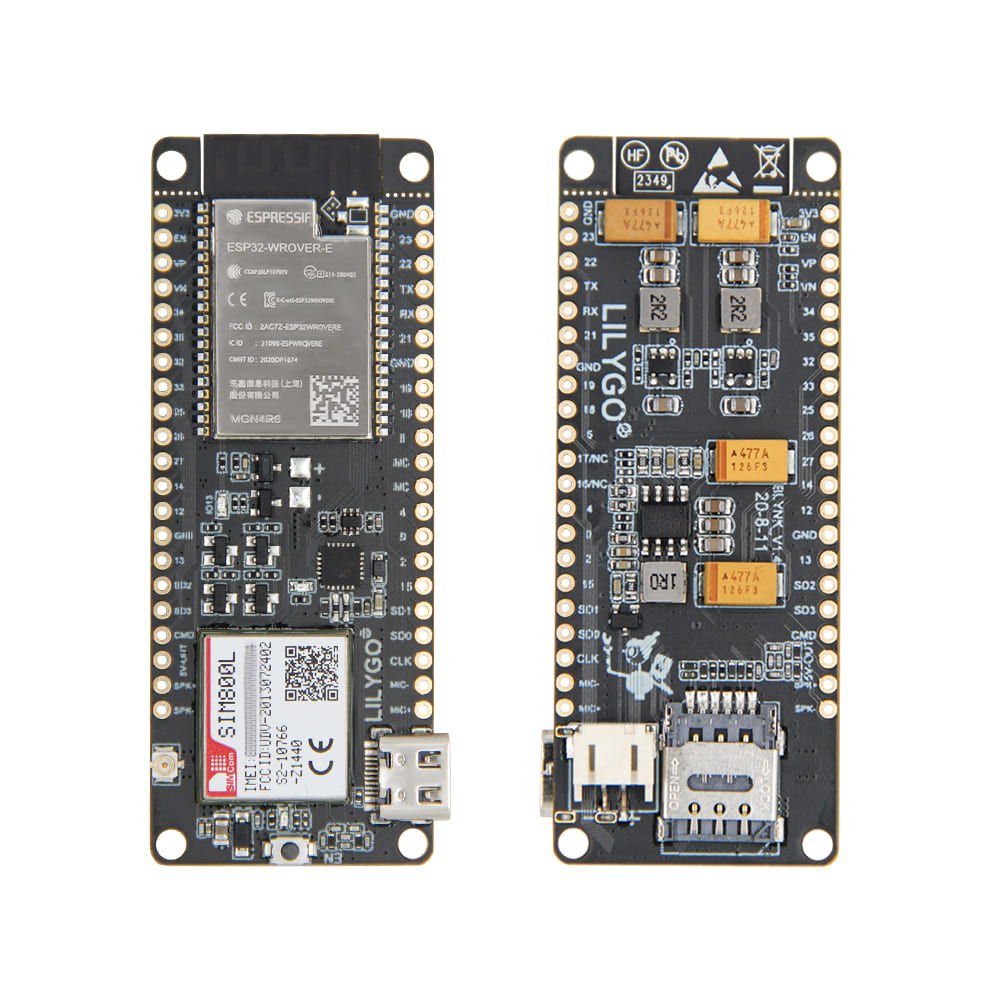
LILYGO T-Call V1.4
An ESP32 development board with an integrated SIM800L or A7670 GSM/LTE cellular modem and SIM card slot, enabling voice, SMS, and data connectivity for IoT projects.
$26.52
Hardware Specifications
Connectivity
Components
Dual-core Xtensa LX6 at 240MHz with integrated Wi-Fi 802.11 b/g/n and Bluetooth 4.2
2G GSM/GPRS/EDGE modem supporting voice calls, SMS, and GPRS data (base variant)
4G LTE Cat-1 modem with 2G fallback, supporting voice and data (A7670 variant)
Lithium battery charging and power management IC
USB to serial bridge chip for programming
Resources


Where to Buy
Overview
The LILYGO T-Call V1.4 is an ESP32 development board with an integrated cellular modem, making it one of the most straightforward platforms for adding GSM voice, SMS, and data capabilities to ESP32 projects. The base variant uses the SIM800L 2G GSM/GPRS/EDGE modem, while an upgraded version uses the A7670E 4G LTE Cat-1 modem for faster data speeds and better network coverage in regions phasing out 2G.
The ESP32 runs at 240MHz with 4MB or 8MB of Flash and supports both Wi-Fi 802.11 b/g/n and Bluetooth 4.2 BR/EDR with BLE. The IP5306 power management chip handles Li-Po battery charging through a JST PH 2.0mm connector, allowing the board to run portably. The CH9102 USB-to-serial chip enables programming via USB Type-C.
The board exposes I2C, SPI, UART, SDIO, I2S, and CAN interfaces, and includes microphone and speaker pin extensions for voice call applications (microphone and speaker not included). An EN button allows the ESP32 to be reset without power cycling.
This board is heavily used in projects that require SMS alerting, GSM remote control, basic cellular data for sending sensor readings, and voice-based IoT applications. The TinyGSM library provides excellent SIM800L and A7670 support, enabling MQTT, HTTP, and TCP/UDP communication through the cellular modem.
Firmware Compatibility
- Arduino: Fully supported. TinyGSM library provides a comprehensive modem abstraction for HTTP, MQTT, TCP, and SMS functionality.
- ESP-IDF: Supported via direct AT command communication with the modem over UART.
Flashing Guide
- Install the CH9102 driver for your operating system.
- Connect the board via USB Type-C cable.
- In Arduino IDE, select "ESP32 Dev Module" and the appropriate COM port.
- Install the TinyGSM library and the ESP32 Arduino board package.
- Insert a nano SIM card (voice + data capable for SIM800L; LTE-compatible for A7670E).
- Connect the included SIM antenna (~7cm) to the antenna connector.
- For SIM800L firmware, see https://github.com/Xinyuan-LilyGO/LilyGo-T-Call-SIM800. For A7670 firmware, see https://github.com/Xinyuan-LilyGO/LilyGO-T-A76XX.
Related Products
ESP32This product page may contain errors. If you find any, please report them.