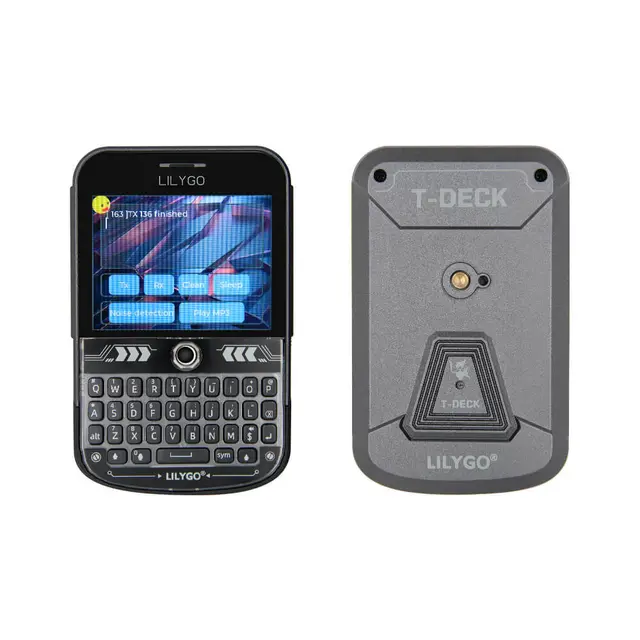
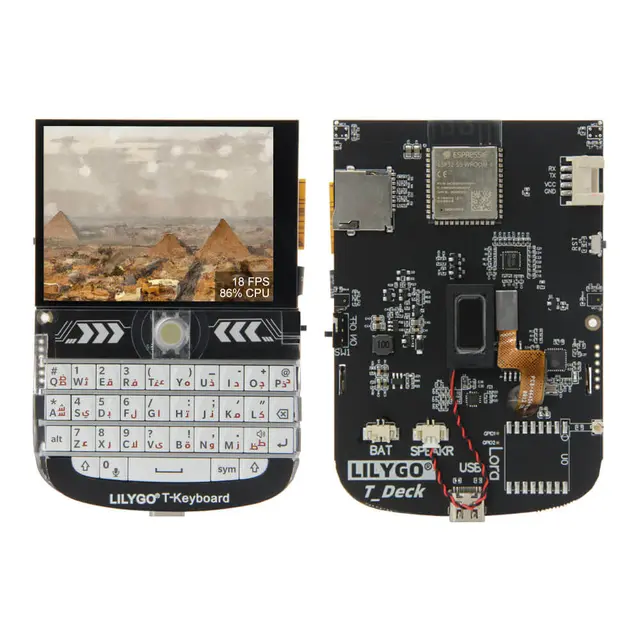
Ripple QWERTY LoRa Mesh Messenger on T-Deck
The Ripple QWERTY firmware turns the LILYGO T-Deck into a standalone encrypted LoRa mesh messenger with GPS, offline maps, group chats, and no internet or cellular connection required.
Overview
Ripple QWERTY is open-source firmware that transforms the LILYGO T-Deck into a fully standalone encrypted mesh messenger, requiring no companion Android device, no internet, and no cellular connection. The project by Scott Powell (spleenware) ports the Ripple LoRa mesh protocol to the T-Deck's ESP32-S3 processor, QWERTY keyboard, and color display, creating a pocket communicator for off-grid use.
How It Works
The T-Deck's built-in SX1262 LoRa radio is used to form a mesh network with other Ripple QWERTY devices or users of the Ripple Messenger Android app. Messages are end-to-end encrypted using ECC cryptography. Devices relay packets through the mesh, extending range well beyond a single radio hop. GPS coordinates can be shared and tracked on the built-in maps interface, which renders raster tiles (OSM/Google Maps format) stored on an SD card.
Key Features
The "Ultra" firmware adds offline map tile rendering with live position dots for all group members, group chats, shared calendars, surveys/quizzes via a "Post Office" store-and-forward repeater, and piezo buzzer alerts for incoming messages. Navigation uses the T-Deck's touchscreen (4-quadrant tap regions) or the built-in trackball. Boot time is fast — the device is usable within seconds of power-on. A mini GPS module connects to the T-Deck's side connector for accurate time and position. The project is beginner-friendly: firmware is installed via web flasher and configuration is done on-device.