Bee Data Logger Deep Sleep SD Card Data Logging
Low-power environmental data logging example using the Bee Data Logger's deep sleep mode (~21uA) with RTC timestamps and SD card storage. Logs sensor readings at configurable intervals for months on a single LiPo battery.
Overview
This project demonstrates the core strength of the Bee Data Logger: ultra-low-power data logging using deep sleep mode with automatic wake-up, RTC timestamping, and SD card storage. The ESP32-S3 enters deep sleep between readings, drawing only ~21µA, allowing the board to run for roughly a year on a 400mAh LiPo battery with readings every 2 hours.
How It Works
- The ESP32-S3 wakes from deep sleep at a configured interval
- The secondary LDO powers up sensors connected via Qwiic/STEMMA QT
- Sensor data is read and timestamped using the DS3231 RTC
- Data is appended to a CSV file on the microSD card (up to 16GB)
- The board returns to deep sleep, shutting off the secondary LDO to save power
Hardware Required
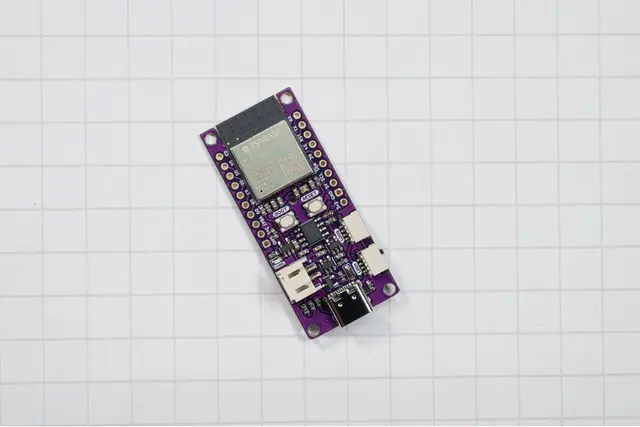
- Bee Data Logger (ESP32-S3 with DS3231 RTC and microSD slot)
- microSD card (up to 16GB)
- CR1220 coin cell battery for RTC backup
- LiPo battery (recommended: Adafruit 3898, 400mAh or larger)
- Any I2C sensor breakout (connected via Qwiic/STEMMA QT)
Software
Example code is available in both CircuitPython and Arduino (via the BeeDataLogger Arduino Helper library). The CircuitPython DeepSleepSD example and the Arduino DeepSleepSD.ino sketch provide ready-to-use implementations.
Power Metrics
The GitHub repo includes detailed power consumption graphs for different CPU frequencies (40MHz, 80MHz, 160MHz, 240MHz) and deep sleep current measurements, helping users optimize battery life for their specific application.