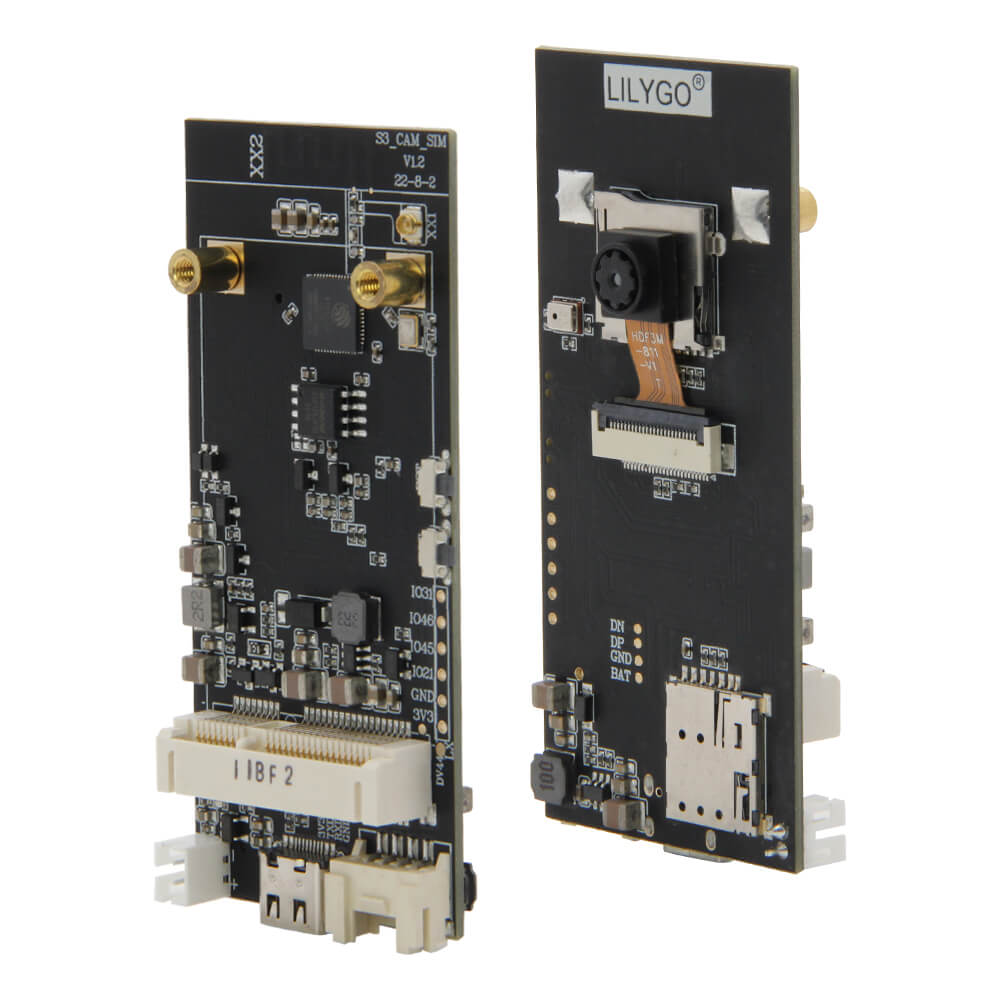
LILYGO T-SimCam
An ESP32-S3 camera development board with mPCIe slot for T-PCIE SIM modules, OV2640/OV5640 camera support, I2S microphone, and microSD card for connected camera and machine vision applications.
$13.86
Hardware Specifications
Connectivity
Components
Dual-core Xtensa LX7 at 240MHz with 512KB SRAM, 8MB PSRAM, integrated Wi-Fi and BLE 5
2-megapixel CMOS image sensor supporting UXGA (1600x1200) resolution at 3.3V (standard variant)
5-megapixel CMOS sensor with optional autofocus and IR-CUT filter (premium variants)
Onboard PDM/I2S microphone for audio capture and voice recognition
Resources


Where to Buy
Overview
The LILYGO T-SimCam is an ESP32-S3 based camera development board that combines machine vision capabilities with an mPCIe expansion slot for T-PCIE cellular modules. The ESP32-S3R8 provides 8MB of PSRAM alongside 16MB Flash and a dual-core Xtensa LX7 running at 240MHz — substantial resources for real-time image processing and AI inference at the edge.
Four camera module variants are available: the standard OV2640 (2MP, $13.86), an OV2640 with IR-CUT filter for day/night use ($17.89), the OV5640 5MP sensor ($21.48), and the OV5640 with autofocus ($23.80) or IR-CUT filter ($23.16). All camera interfaces use a standard MIPI/DVP camera connector, and the board supports the ESP32-S3's hardware JPEG encoder for fast image compression.
The onboard I2S digital microphone enables audio capture for voice command recognition, sound detection, and recording applications. A microSD card slot provides local storage for captured images and audio. Boot and Reset buttons are included for easy development.
The mPCIe slot accepts T-PCIE SIM modules (sold separately) supporting a wide range of cellular protocols — from LTE Cat-M and NB-IoT to LTE Cat-4 — enabling the camera to upload images and video over cellular networks without Wi-Fi infrastructure. This makes the T-SimCam ideal for remote security cameras, wildlife monitoring, industrial inspection systems, and edge AI applications that need cellular backhaul.
Firmware Compatibility
- Arduino: Supported via the ESP32 Arduino core with ESP32-S3 target. Use the esp32-camera library for image capture and the ESP-WHO framework for face detection.
- ESP-IDF: Fully supported with native camera driver (esp_camera component) and HTTP streaming libraries.
Flashing Guide
- Connect via USB Type-C cable.
- In Arduino IDE, select "ESP32S3 Dev Module" and configure with 16MB Flash and 8MB PSRAM (OPI mode).
- Install the esp32-camera library for image capture functionality.
- For cellular connectivity, install the T-PCIE SIM module into the mPCIe slot and install the appropriate TinyGSM or AT command library.
- Hold BOOT while pressing RST to enter download mode if auto-reset fails.
- Refer to https://github.com/Xinyuan-LilyGO/LilyGo-Camera-Series for complete examples and pinout diagrams.
Related Products
ESP32-S3This product page may contain errors. If you find any, please report them.