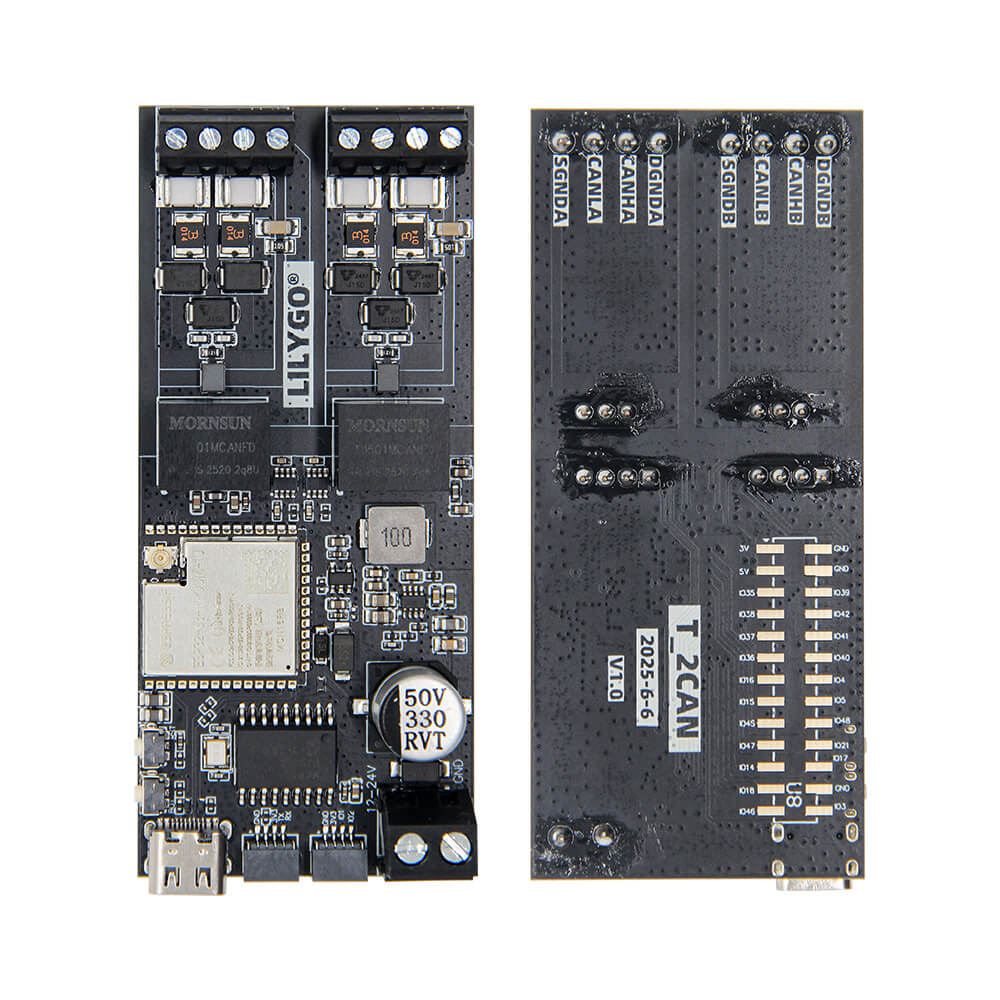
LILYGO T-2CAN
ESP32-S3 board with dual electrically isolated CAN bus interfaces, DC 5–12V input, 16MB flash, and 8MB PSRAM. Ideal for automotive diagnostics and industrial CAN network applications.
$24.36
Hardware Specifications
Connectivity
Components
Dual-core Xtensa LX7 at 240MHz with 2.4GHz Wi-Fi and BLE 5
Dual isolated CAN bus transceivers with onboard 120Ω termination resistors

Where to Buy
Overview
The LILYGO T-2CAN is a development board built around the ESP32-S3 that provides two fully electrically isolated CAN bus interfaces, making it well-suited for automotive, industrial, and energy applications where bus isolation is critical. The dual isolated CAN channels prevent ground loops and protect the MCU from transient voltages that are common in vehicle or factory environments.
Each CAN channel includes an onboard 120-ohm termination resistor, which is required at CAN bus endpoints and eliminates the need for external resistors during prototyping. The board accepts a wide DC power input of 5–12V in addition to USB-C, making it easy to power directly from vehicle 12V systems or industrial 24V (with a step-down) without an external regulator.
Key features:
- ESP32-S3 with 16MB flash and 8MB PSRAM
- Dual electrically isolated CAN bus interfaces
- Onboard 120Ω CAN termination resistors on both channels
- DC 5–12V wide-range power input via barrel connector
- USB-C for programming and power
- BOOT and RESET buttons onboard
- Wi-Fi 802.11 b/g/n and Bluetooth 5 LE for wireless connectivity
The board is particularly useful for battery management system (BMS) emulation, OBD-II bridging, CANopen node development, and scenarios that require routing CAN traffic between isolated domains over Wi-Fi or BLE.
Firmware Compatibility
- Arduino: Full support using the
arduino-esp32package. Use theESP32-S3 Dev Moduleboard target. TheESP32SJA1000orTWAIdriver provides native CAN support on ESP32-S3. LilyGO provides example sketches in the GitHub repository. - ESP-IDF: Native support via the TWAI (Two-Wire Automotive Interface) peripheral driver. Supports standard and extended CAN frames, multiple operating modes (normal, listen-only, self-test), and configurable bitrates up to 1Mbps.
- PlatformIO: Works with the
espressif32platform targetingesp32-s3-devkitc-1. Configure the TWAI peripheral viadriver/twai.h.
Flashing Guide
- Connect the T-2CAN to your computer using a USB-C cable.
- The board should enumerate as a serial port automatically on most operating systems.
- If the board does not enter download mode, hold the BOOT button while pressing and releasing RESET, then release BOOT.
- For Arduino IDE: install the ESP32 board package (v2.x or later) and select ESP32S3 Dev Module. Set PSRAM to OPI PSRAM (8MB).
- For ESP-IDF, build and flash using:
idf.py -p /dev/ttyUSB0 flash monitor - For esptool:
esptool.py --chip esp32s3 --port /dev/ttyUSB0 --baud 921600 write_flash -z 0x0 firmware.bin - After flashing, press RESET to run the new firmware.
- Refer to the GitHub repository for pinout diagrams and CAN bus example code.
Related Products
ESP32-S3This product page may contain errors. If you find any, please report them.