Multi-Band LoRaWAN Sensor Node with T3-S3 LR1121
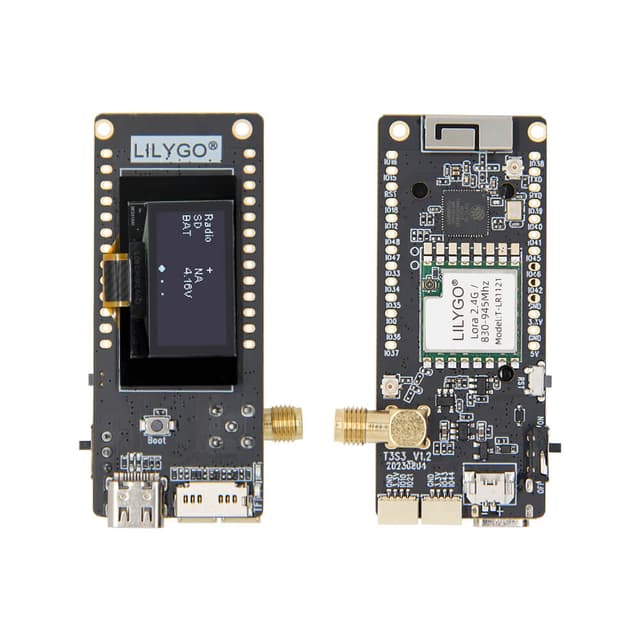
A LoRaWAN sensor node built on the LILYGO T3-S3 LR1121, leveraging the LR1121 chip's multi-band capability to operate on Sub-GHz (433/868/915 MHz) and 2.4 GHz frequencies from a single hardware platform.
Overview
The LILYGO T3-S3 LR1121 pairs the ESP32-S3 microcontroller with Semtech's LR1121 radio chip — a unique device that supports LoRa and LoRaWAN across Sub-GHz bands (433 MHz, 868 MHz, 915 MHz) and 2.4 GHz from a single chip. This makes it ideal for building sensor nodes that need to operate across different regional frequency plans, or for testing multi-band LoRa deployments without swapping hardware.
Use Cases
A typical deployment uses the T3-S3 LR1121 as a LoRaWAN OTAA node sending periodic environmental sensor readings (temperature, humidity, pressure via BME280) to The Things Network or Chirpstack. The RadioLib library provides a unified API for all LR1121 frequency bands. The built-in 0.96" OLED displays connection status and sensor data locally, while the microSD slot enables local data logging as a fallback when network connectivity is unavailable.
Getting Started
Build with PlatformIO: open the LilyGo-LoRa-Series repository in VS Code, select t3-s3-lr1121 as the board in platformio.ini, and use the RadioLib_OTAA example as a starting point. Connect the included IPEX antenna before powering on. Configure your TTN Application credentials in the sketch and select the frequency band matching your region.