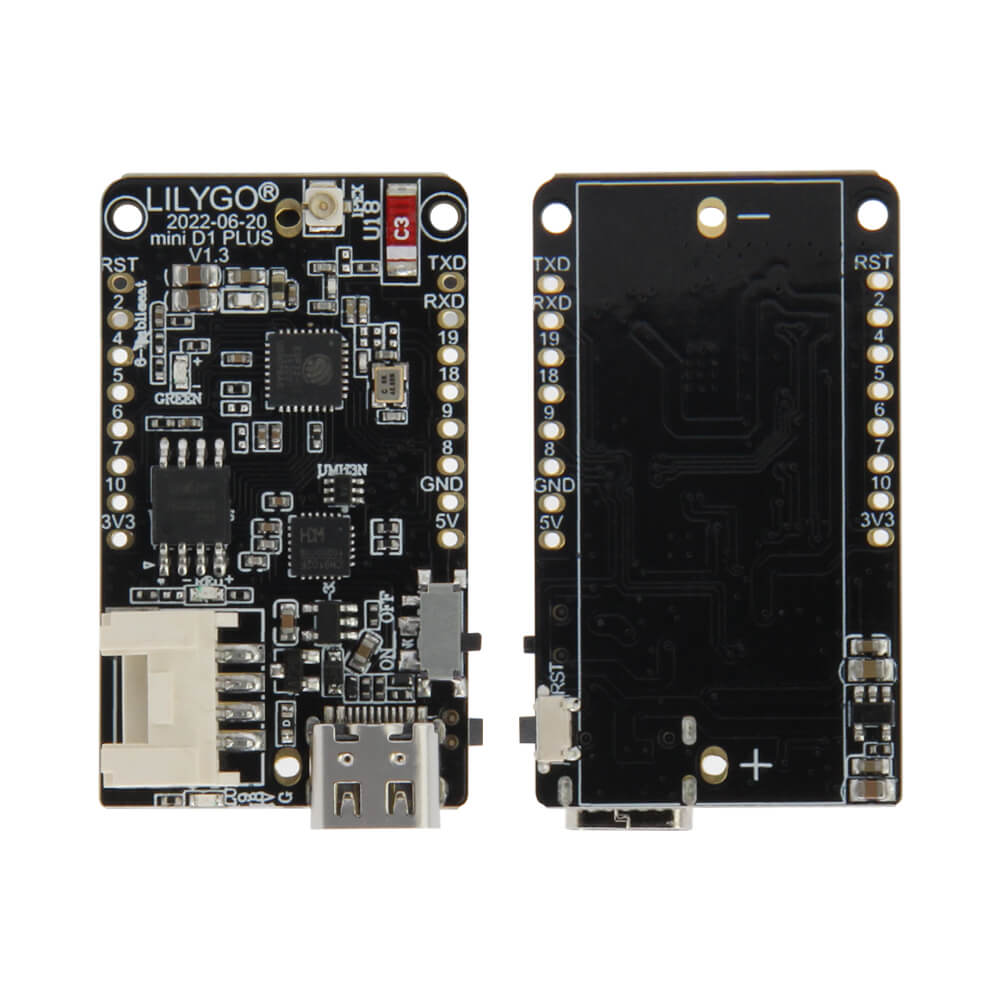
LILYGO T-OI Plus
A compact ESP32-C3 RISC-V development board with a Grove connector and optional 16340 battery holder, offering Wi-Fi and Bluetooth 5 Mesh for minimal-footprint IoT sensor nodes.
$5.50
Hardware Specifications
Connectivity
Components
RISC-V 32-bit SoC at 160MHz with 400KB SRAM, 384KB ROM, 8KB RTC SRAM, integrated Wi-Fi and Bluetooth 5 Mesh
Compact USB to serial bridge chip for programming
Resources


Where to Buy
Overview
The LILYGO T-OI Plus is a low-cost, compact development board built around the ESP32-C3 RISC-V SoC. At just $5.50, it offers an accessible entry point to the ESP32-C3 ecosystem with Wi-Fi 802.11 b/g/n and Bluetooth 5 Mesh in a tiny form factor suitable for embedded sensor nodes and battery-powered edge devices.
The ESP32-C3 features a 32-bit RISC-V core running at 160MHz, 400KB SRAM, 384KB ROM, 8KB RTC SRAM, and 4MB of Flash. It provides 2x 12-bit SAR ADC channels (up to 6 channels total), 3x SPI, 2x UART, I2C, I2S, LED PWM, TWAI (CAN), timers, RMT, and USB serial interfaces — a comprehensive peripheral set for its size.
A 4-pin Grove connector (2.0mm pitch) makes sensor attachment straightforward without soldering, supporting standard I2C Grove modules. The optional 16340 cylindrical lithium battery holder (not included) enables portable operation; the board includes battery charging circuitry. Two variants are available: with battery holder (Q369) or without (Q370).
The CH340K USB chip handles programming via USB Type-C. Schematics and quick-start firmware are available in the GitHub repository, making it easy to get started with ESPHome for Home Assistant integration or custom Arduino/MicroPython projects.
Firmware Compatibility
- ESPHome: Fully supported with ESP32-C3 target. Excellent for Home Assistant sensor nodes.
- Arduino: Supported via the ESP32 Arduino core with ESP32-C3 board target.
- ESP-IDF: Supported with access to all peripherals.
- MicroPython: Supported on ESP32-C3.
Flashing Guide
- Install the CH340K USB driver if needed (most modern systems detect it automatically).
- Connect via USB Type-C cable.
- For ESPHome: add a new device with the ESP32-C3 platform and flash via USB.
- For Arduino: select "ESP32C3 Dev Module" in Arduino IDE and upload.
- To enter bootloader mode manually: hold the BOOT button while pressing RST.
- Refer to https://github.com/Xinyuan-LilyGO/LilyGo-T-OI-PLUS for schematics and examples.
Related Products
ESP32-C3This product page may contain errors. If you find any, please report them.