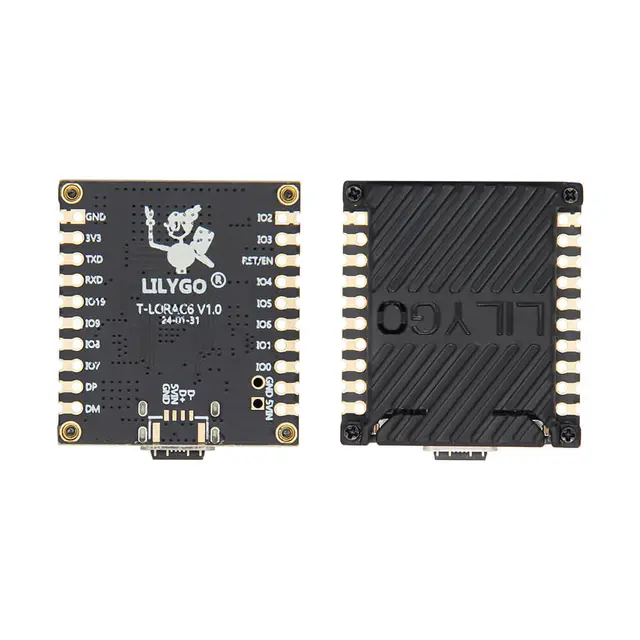
LoRaWAN Node with WiFi 6 and 802.15.4 on T-Lora C6
A LoRaWAN OTAA sensor node built on the LILYGO T-Lora C6, combining SX1262 long-range LoRa radio with the ESP32-C6's native WiFi 6, Bluetooth 5, and 802.15.4 (Zigbee/Thread) connectivity for versatile IoT gateway applications.
Overview
The LILYGO T-Lora C6 is a compact board that uniquely pairs an SX1262 LoRa transceiver with the ESP32-C6 — Espressif's first RISC-V chip supporting WiFi 6 (802.11ax), Bluetooth 5, and 802.15.4 (the physical layer used by Zigbee and Thread/Matter). This makes it possible to build IoT nodes that bridge LoRa sensor data to Zigbee or Thread networks, or act as a LoRaWAN node while simultaneously maintaining a WiFi 6 uplink.
LoRaWAN Setup
Using the RadioLib library with PlatformIO, the T-Lora C6 connects to The Things Network (or any LoRaWAN server) via OTAA activation on 868 MHz, 915 MHz, or 433 MHz bands. The SX1262 provides excellent sensitivity (-148 dBm) and programmable output power up to +22 dBm. The official LilyGo-LoRa-Series repository provides a RadioLib_OTAA example specifically configured for the T3-C6 board pinout.
802.15.4 Potential
The ESP32-C6's integrated 802.15.4 radio enables experimentation with Zigbee coordinator/router roles or Thread border routing alongside LoRa operation. This dual-radio architecture — long-range LoRa for backhaul and short-range 802.15.4 for local mesh — is well-suited for building low-power sensor networks in agricultural, industrial, or smart building environments where both local device coordination and wide-area connectivity are needed.