Build Guideadvanced
VoltLink Open Source KiCad Hardware Design
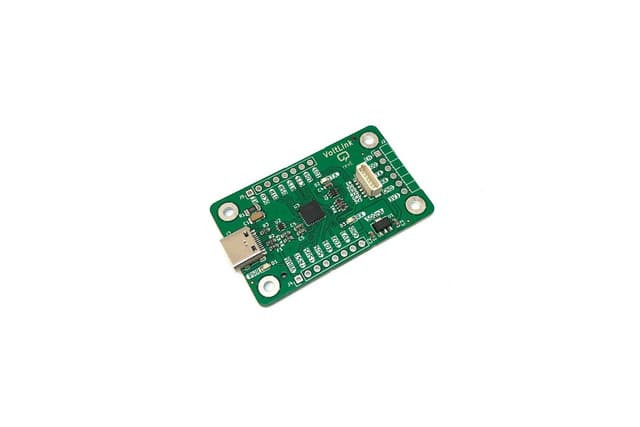
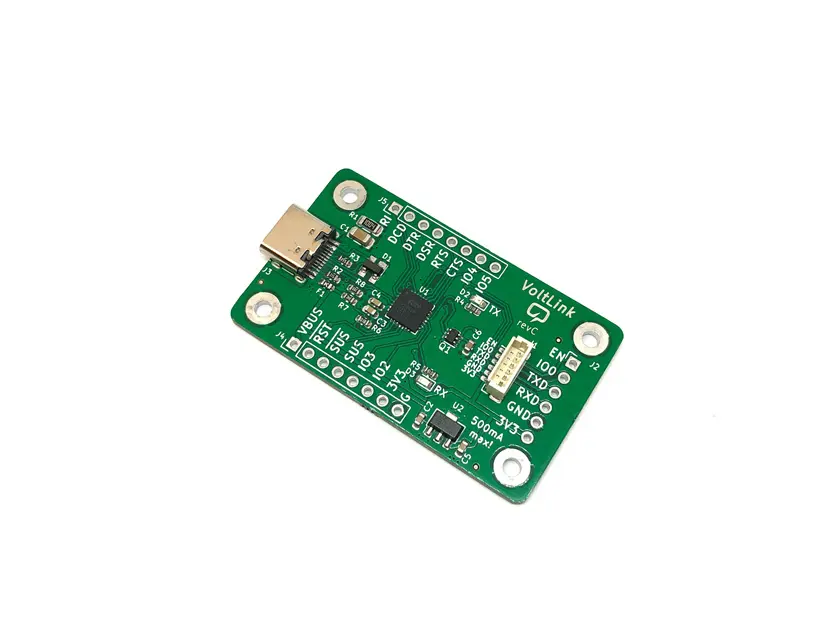
Complete open-source KiCad PCB design files for the VoltLink CP2102N USB-to-serial adapter and ESP32 programmer, including schematics, board layout, BOM, and Gerber files for DIY manufacturing.
Use Cases:programming
The VoltLink is an open-source USB-to-serial adapter designed by Voltlog, built around the genuine Silabs CP2102N chip. The GitHub repository contains the full KiCad project files needed to manufacture your own VoltLink board.
Repository Contents
- KiCad schematic (
link.kicad_sch) — full circuit design with CP2102N, auto-reset circuitry, ESD protection, and 3.3V LDO regulator - KiCad PCB layout (
link.kicad_pcb) — board layout with USB-C connector, JST-SH connector, and 0.1" headers - Bill of Materials (
BOM/) — component list for sourcing parts - Gerber files (
gerbers/) — ready-to-order fabrication files - Centroid file (
Centroid/) — pick-and-place data for automated assembly - Schematic PDF (
VoltLink_schematic_revE.pdf) — printable schematic reference
Design Highlights
The VoltLink design has evolved through multiple revisions (A through E), each improving manufacturability, component sourcing, and protection features. Key design decisions include:
- Genuine CP2102N in QFN28 package — sourced from reputable distributors for reliable high-speed serial communication up to 3M baud
- ESP32 auto-reset circuitry — automatically toggles EN and IO0 pins to enter bootloader mode, eliminating manual button presses during firmware uploads
- USB Type-C with ESD protection on data lines and VBUS
- 500mA overcurrent protection and 3.3V 500mA LDO regulator capable of powering target boards during programming
- Dual connector options — standard 0.1" pin headers and JST-SH 1.0mm pitch connector for compact designs
Revision History
- Rev A (Voltlog #356) — Original design with CP2104 chip
- Rev B (Voltlog #396) — Switched to CP2102N QFN28, upgraded ESD protection diode
- Rev C (Voltlog #405) — Manufacturing optimizations, no functional changes
- Rev D (Voltlog #414) — Added power LED, resistor network consolidation, increased decoupling capacitor to 10µF
- Rev E — Current revision with schematic refinements