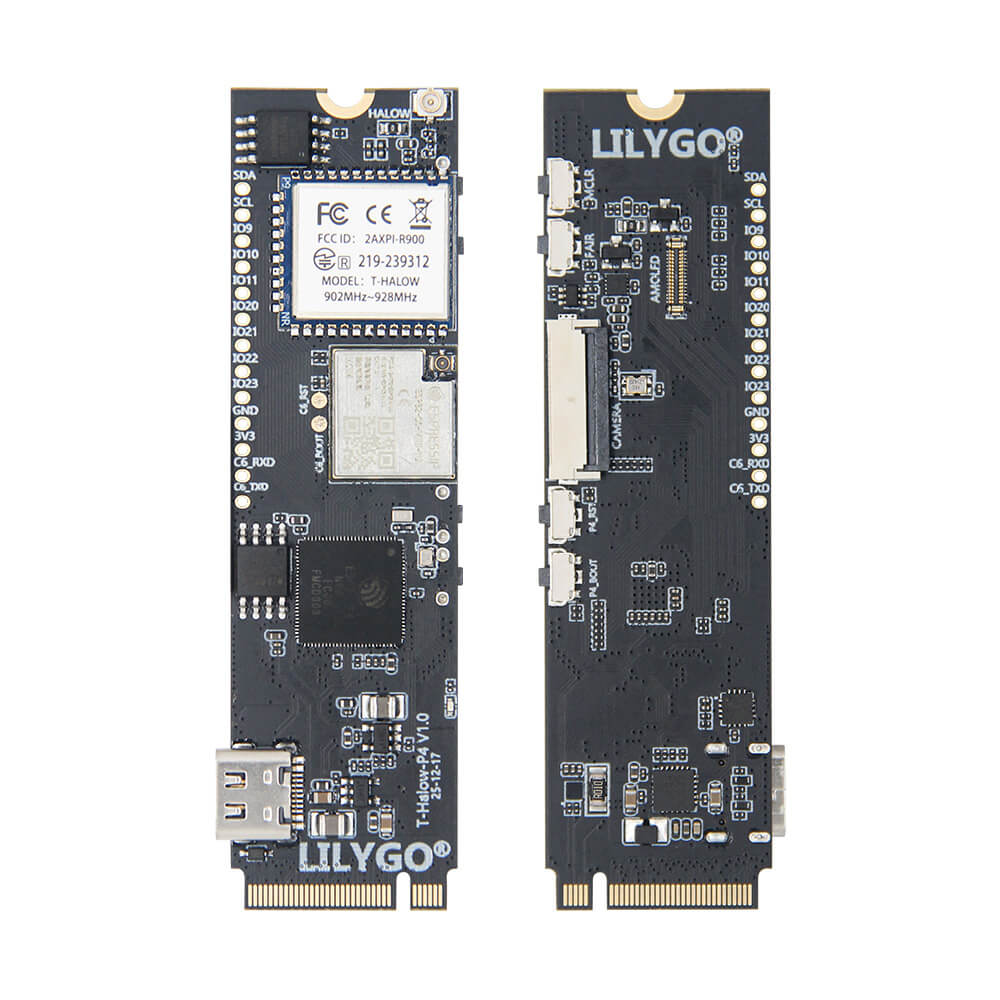
LILYGO T-Halow P4
A high-performance ESP32-P4 development board with an onboard ESP32-C6 for WiFi 6 and BLE, featuring MIPI-CSI/DSI interfaces and H.264 video encoding at 1080p@30fps.
$0.00
Hardware Specifications
Connectivity
Components
RISC-V dual-core @ up to 400 MHz with 16MB Flash and 8MB PSRAM, H.264 encoder, MIPI CSI/DSI
Secondary MCU providing WiFi 6 (802.11ax) and BLE 5 connectivity

Where to Buy
Overview
The LILYGO T-Halow P4 is a high-performance development board combining the ESP32-P4 high-performance RISC-V processor with the ESP32-C6 for WiFi 6 (802.11ax) and BLE 5 wireless connectivity. The "Halow" designation refers to WiFi HaLow (802.11ah) long-range, low-power WiFi capabilities provided by the ESP32-C6's advanced wireless features.
Built with MIPI-CSI and MIPI-DSI interfaces, the T-Halow P4 supports high-resolution camera modules and displays via the industry-standard MIPI bus. The ESP32-P4's integrated H.264 hardware encoder enables video encoding at 1080p@30fps, making it suitable for video streaming and surveillance applications. With 16MB of Flash and 8MB of PSRAM, there is ample memory for demanding multimedia workloads.
The SKU H777 targets the 915 MHz band. The board is aimed at developers building advanced IoT applications requiring high-speed processing, camera integration, and next-generation WiFi connectivity. It supports Arduino IDE, VS Code, and ESP-IDF development environments.
Firmware Compatibility
- ESP-IDF — Recommended for full access to ESP32-P4 capabilities including H.264 encoding, MIPI interfaces, and advanced WiFi 6 features.
- Arduino — Arduino ESP32 core v3.x+ includes basic ESP32-P4 support.
- VS Code + PlatformIO — Suitable for structured project management.
Flashing Guide
- Install ESP-IDF v5.3+ which includes ESP32-P4 support.
- Connect the T-Halow P4 via USB-C.
- Set the build target:
idf.py set-target esp32p4. - Clone LILYGO's GitHub repository for board-specific configurations and examples.
- Build and flash:
idf.py build flash monitor. - For Arduino: use ESP32 Arduino core v3.1.0+ with ESP32-P4 board support and set the appropriate Flash and PSRAM settings.
Related Products
ESP32-P4This product page may contain errors. If you find any, please report them.