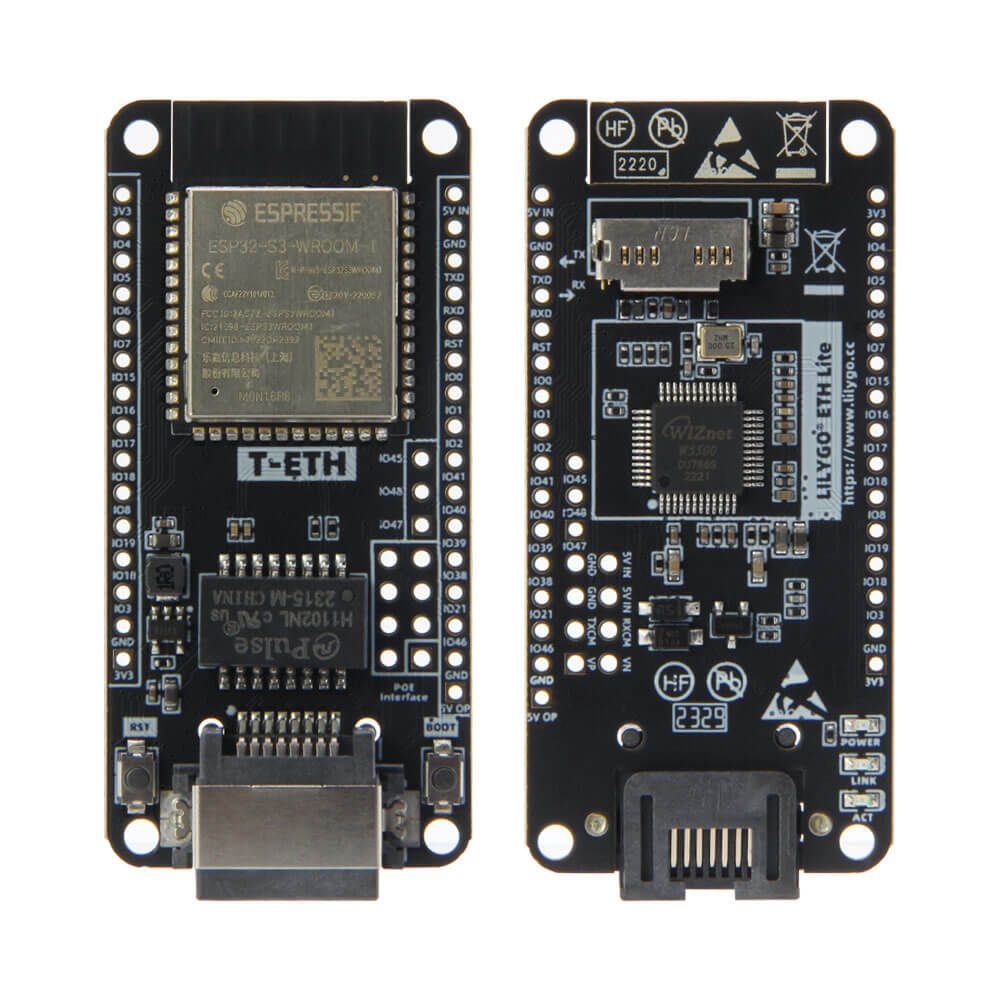
LILYGO T-ETH Lite
The T-ETH Lite is an ESP32 or ESP32-S3-based development board with integrated Ethernet (RTL8201 or W5500), WiFi, and Bluetooth, available with optional camera shield and PoE shield accessories.
$13.30
Hardware Specifications
Connectivity
Components
ESP32 variant: 16MB Flash, 8MB PSRAM, WiFi b/g/n, BT 4.2. ESP32-S3 variant: 16MB Flash, 8MB PSRAM, WiFi b/g/n, BLE 5
Ethernet controller: RTL8201 on ESP32 variant, W5500 on ESP32-S3 variant
Resources


Where to Buy
Overview
The LILYGO T-ETH Lite is a compact and affordable Ethernet-enabled development board available in two MCU variants. The ESP32 version uses an ESP32-WOVER-E module with an RTL8201 Ethernet controller, while the ESP32-S3 version uses an ESP32-S3-WROOM-1 module with a W5500 Ethernet controller. Both variants include 16MB flash and 8MB PSRAM.
Both versions offer wired Ethernet connectivity alongside integrated 2.4 GHz WiFi and Bluetooth, making the T-ETH Lite ideal for applications requiring reliable wired network connectivity with wireless fallback. A TF card slot is included for local storage. Reset and Boot buttons support standard ESP32 programming workflows.
Optional accessories expand the board's capabilities: the Camera Shield ($11.24) adds camera functionality to the ESP32-S3 variant, while the POE Shield ($11.43) enables Power-over-Ethernet for cable-only deployments. The board is well-suited for network gateways, home automation hubs, industrial controllers, and any IoT application requiring stable wired connectivity.
Firmware Compatibility
- Arduino: Supported via Espressif Arduino core with Ethernet library support for both RTL8201 and W5500.
- ESP-IDF: Native framework with full Ethernet hardware support.
- ESPHome: Compatible with Ethernet component configuration.
- Tasmota: Supported with Ethernet-enabled build.
Documentation and examples: LilyGO-T-ETH-Series.
Flashing Guide
- Connect the T-ETH Lite to your computer via USB-C cable.
- Hold BOOT, press RESET, release RESET, then release BOOT to enter download mode.
- In Arduino IDE, select ESP32 Dev Module (for ESP32 variant) or ESP32S3 Dev Module (for S3 variant) with 16MB flash.
- Upload the firmware.
- Connect an Ethernet cable to the RJ45 port for wired network access.
- For PoE deployments, attach the POE Shield and connect a PoE-capable switch or injector.
This product page may contain errors. If you find any, please report them.