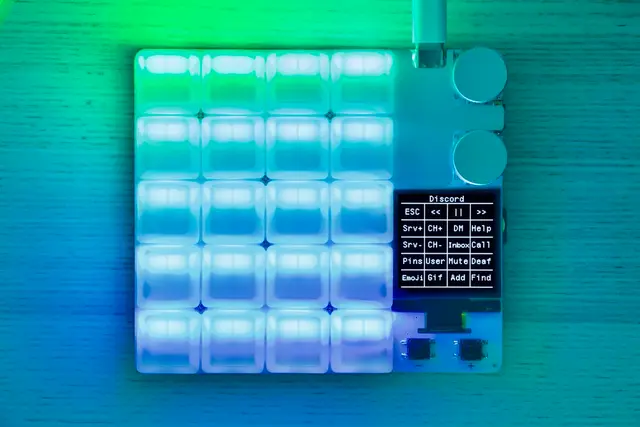
Micro Journal Rev.3: Nadia
A 48-key ortholinear mechanical keyboard designed as a distraction-free writing companion for phones and tablets, powered by RP2040 with QMK/Vial firmware and dual rotary encoders.
$99.00
Tap any value to browse matching devices
Specifications
Components
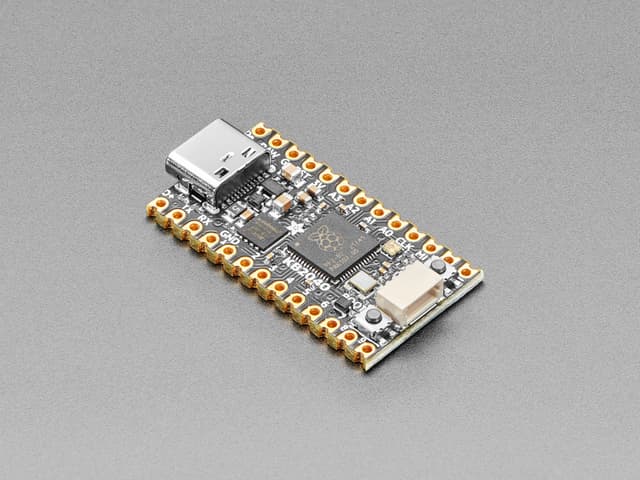
Raspberry Pi RP2040 dual-core ARM Cortex-M0+ microcontroller at 133MHz with 264KB SRAM and 8 PIO state machines
Alps Alpine EC11 incremental rotary encoder with push-button switch
High-speed switching diode for keyboard matrix anti-ghosting
Bus Interfaces
GPIO Map
Overview
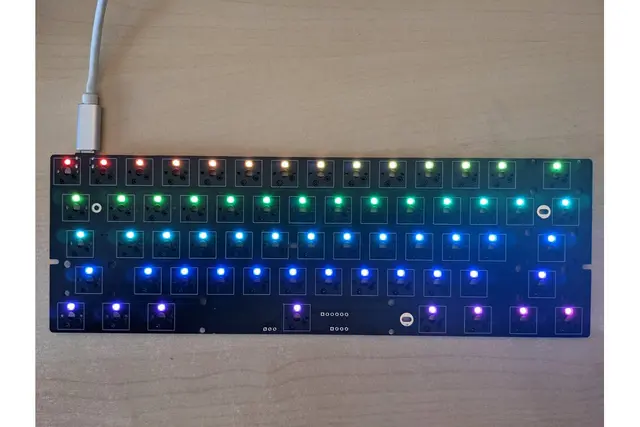
The Micro Journal Rev.3: Nadia is a compact 48-key ortholinear mechanical keyboard designed as a companion for phones and tablets, turning them into distraction-free writing stations. Built around a Raspberry Pi Pico (RP2040), it runs QMK/Vial firmware and features Cherry MX-compatible hot-swap sockets with two rotary encoders for additional input control.
Part of the Micro Journal series by Un Kyu Lee, the Rev.3 "Nadia" is the keyboard-only variant — it pairs with a phone or tablet via USB-C OTG for a minimal, focused writing experience without the distractions of a full computer.
Key Features
- 48-key ortholinear layout with Cherry MX-compatible hot-swap sockets
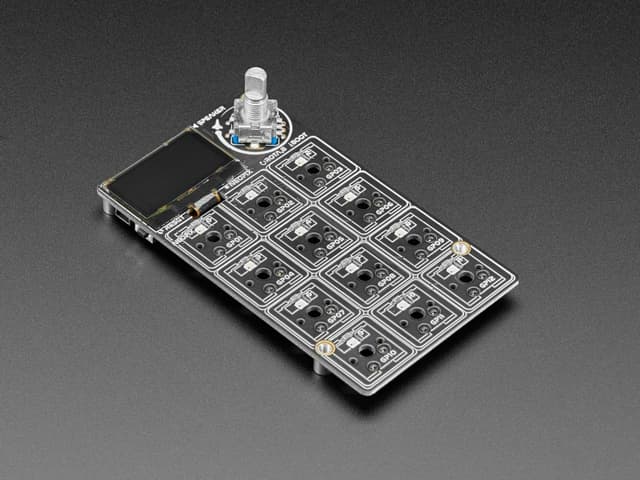
- Dual rotary encoders (EC11) for scrolling, volume, or custom functions
- QMK/Vial firmware — fully programmable layers, macros, and real-time keymap editing via Vial GUI
- USB-C connection — plug into any phone, tablet, or computer as a standard USB HID keyboard
- RP2040 powered — Raspberry Pi Pico with dual-core ARM Cortex-M0+ at 133MHz
- Open-source design — PCB files and firmware available on GitHub
Hardware Design
The keyboard uses a 12-column x 5-row matrix with 1N4148 switching diodes for N-key rollover anti-ghosting. The matrix is scanned by the RP2040 using GPIO pins GP2-GP18, while two EC11 rotary encoders are connected to GP19-GP22.
The PCB is designed for Cherry MX-compatible hot-swap sockets, allowing switch changes without soldering. The board connects via USB-C and presents as a standard USB HID keyboard device.
Firmware
The device ships with Vial firmware (built on QMK), enabling real-time keymap configuration through the Vial desktop application without recompilation. Users can customize:
- Multiple keyboard layers
- Macros and tap-dance keys
- Rotary encoder functions per layer
- LED underglow effects (if LEDs are added)
Use Case
The Micro Journal Rev.3 is designed for writers who want a dedicated, portable writing device. Connect it to a phone or tablet running a writing app (Google Docs, iA Writer, etc.) via USB-C OTG, and you have a distraction-free writing station that fits in a bag. The ortholinear layout and mechanical switches provide a satisfying typing experience, while the rotary encoders offer quick access to scrolling or undo/redo functions.
Community
The Micro Journal project has an active community across Reddit (r/writerDeck), with coverage on Boing Boing, Hackster.io, and various maker blogs. The Rev.3 Nadia is available as a kit or assembled unit on Tindie.
Use Cases
2Resources
Where to Buy
Explore more of the directory — popular use cases, firmware, and specs to browse next.