ESP32 WiFi Fancontroller
ESP32-S2-based WiFi fan controller with 4 independent PWM outputs, integrated HDC1080 temperature and humidity sensor, Qwiic expansion, and native Home Assistant integration via ESPHome.
$54.99
Tap any value to browse matching devices
Specifications
Certifications
Components
Espressif single-core 32-bit Xtensa LX7 WiFi SoC running at 240 MHz with 320 KB SRAM, 43 GPIOs, and native USB support.
Texas Instruments 14-bit digital humidity and temperature sensor with +/-0.2C and +/-2% RH accuracy, I2C interface, and 100 nA sleep current.
SparkFun-standard JST SH 4-pin I2C connector for plug-and-play sensor expansion without soldering.
Bus Interfaces
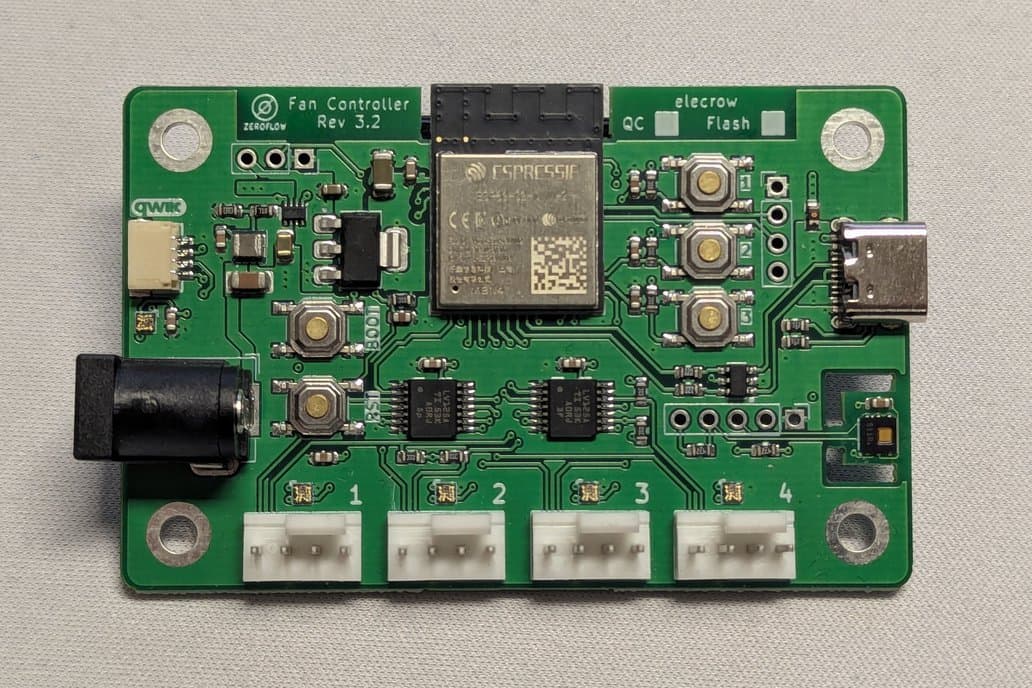
The ESP32 WiFi Fancontroller is an open-source, CE-certified board designed to bring smart, temperature-driven fan control to server racks, grow tents, 3D printer enclosures, and any space that needs automated ventilation. Built around the ESP32-S2 microcontroller, it provides four independent 12V PWM fan outputs with RPM monitoring on each channel, all controllable over WiFi through Home Assistant. An integrated HDC1080 temperature and humidity sensor feeds real-time climate data into configurable control loops — including linear curve interpolation and full PID regulation — so fans ramp up and down automatically without any cloud dependency.
Expansion is straightforward thanks to a Qwiic (I2C) port for plug-and-play sensors, a standard 2.54mm I2C header, a 5V NeoPixel output for status LEDs, and GPIO breakout pads for custom wiring. Three programmable buttons on the board can trigger Home Assistant automations directly. The board ships pre-flashed with ESPHome firmware and can be reflashed over USB-C or OTA, making initial setup as simple as opening a browser and connecting to WiFi.
The hardware design — schematics, PCB layout, and firmware — is fully open source under the GPLv3 license, with all files available on GitHub. Power consumption sits at just 0.25W in normal operation and drops to 0.07W in deep sleep, keeping the board efficient even when running 24/7. An optional 3D-printed nylon case is available for clean mounting in racks or enclosures.
Use Cases
7Fan Control
Automated PWM fan speed control based on temperature, humidity, or manual setpoints.
home-automation
HVAC Control
Smart HVAC control systems for monitoring and managing heating, ventilation, and air conditioning.
Server Rack Cooling
Temperature-controlled fan management for server racks and network equipment enclosures.
Ventilation Control
Smart ventilation controllers for managing mechanical ventilation units, air flow, and indoor air quality.
Grow Tent Ventilation
Automated fan and ventilation control for indoor grow tents and greenhouses with climate monitoring.
Environmental Monitoring
Monitoring environmental conditions like temperature, humidity, air quality, and weather data using remote sensors.
Resources
Where to Buy
Explore more of the directory — popular use cases, firmware, and specs to browse next.