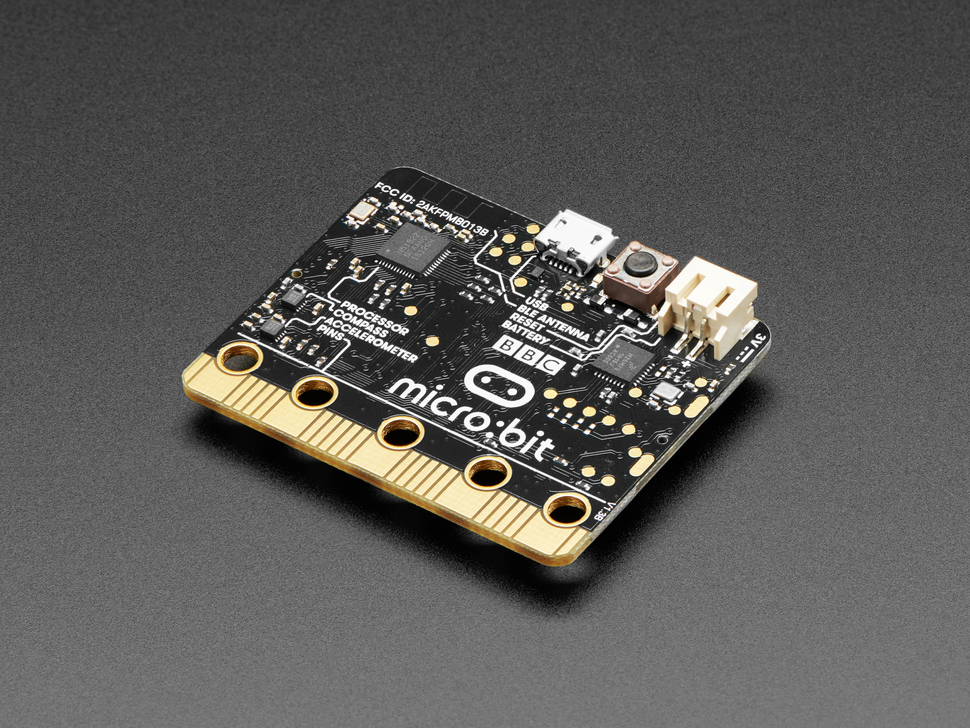
# BBC micro:bit v1

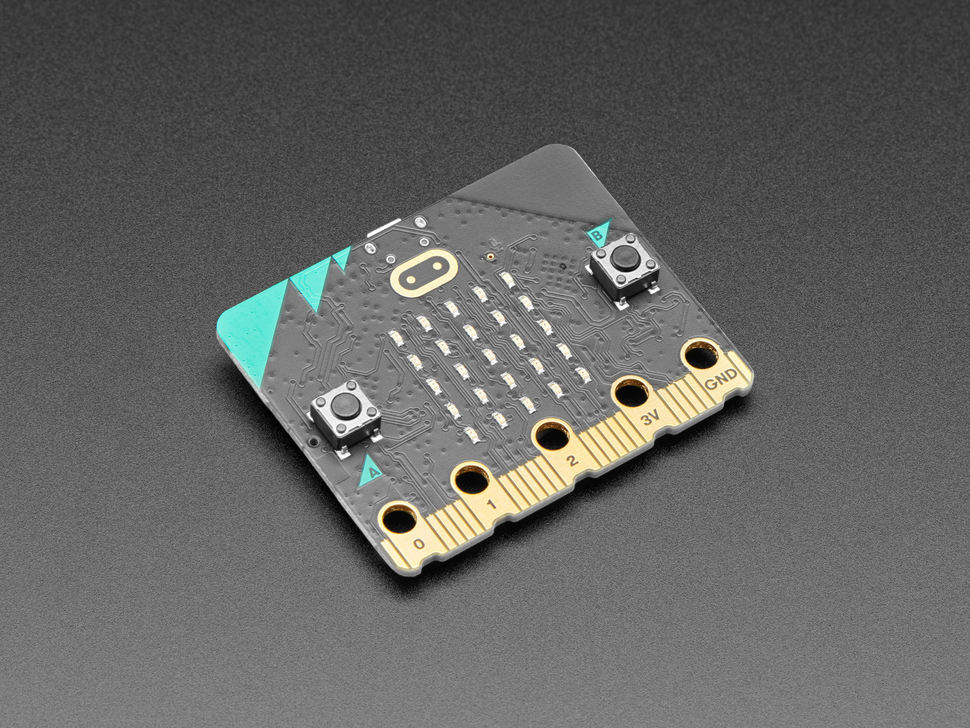
> Pocket-sized educational microcontroller with nRF51822, 5×5 LED matrix, accelerometer, magnetometer, Bluetooth LE, 2 buttons, and 19 I/O pins. Designed for teaching coding to children and beginners via MakeCode or MicroPython.

## Quick Facts

- **Brand:** BBC micro:bit
- **Board Type:** dev-board
- **Price:** ~$14.95
- **Product Readiness:** consumer
- **CPU:** Nordic nRF51822 ARM Cortex-M0
- **CPU Architecture:** ARM Cortex-M0
- **CPU Cores:** 1
- **RAM:** 16 KB
- **Flash:** 256 KB
- **Power:** 5V via Micro USB or 3V via 2x AAA batteries
- **Operating Voltage:** 3.3V
- **Dimensions:** 52mm × 42.1mm × 11mm
- **Weight:** 9g

## Connectivity

- **Bluetooth:** Bluetooth 4.0 LE

## Open Source

- **Firmware:** Yes
- **Schematics:** Yes
- **PCB Layout:** No

## Compatible Firmware

micropython, arduino

## Use Cases

- education
- kids-coding
- stem
- wearable
- iot-prototyping

## Components

- **nRF51822** (mcu): ARM Cortex-M0 SoC with integrated Bluetooth 4.0 LE radio at 16 MHz. — [Datasheet](https://openhardware.directory/r?to=https%3A%2F%2Finfocenter.nordicsemi.com%2Fpdf%2FnRF51822_PS_v3.1.pdf&ref=openhardware.directory&product=bbc-microbit-v1&source=md-export)
- **MMA8652FC** (imu): 3-axis 12-bit MEMS accelerometer for motion and tilt detection. — [Datasheet](https://openhardware.directory/r?to=https%3A%2F%2Fwww.nxp.com%2Fdocs%2Fen%2Fdata-sheet%2FMMA8652FC.pdf&ref=openhardware.directory&product=bbc-microbit-v1&source=md-export)
- **MAG3110** (sensor): 3-axis digital magnetometer providing compass heading and magnetic field data. — [Datasheet](https://openhardware.directory/r?to=https%3A%2F%2Fwww.nxp.com%2Fdocs%2Fen%2Fdata-sheet%2FMAG3110.pdf&ref=openhardware.directory&product=bbc-microbit-v1&source=md-export)

## Protocols

- **I2C**: SDA: P20, SCL: P19
- **SPI**: MOSI: P15, MISO: P14, SCK: P13
- **UART**: TX: P0, RX: P1
- **Bluetooth LE**: 

## GPIO Map

| Pin | Name | Type | Functions |
|-----|------|------|-----------|
| P0 | GPIO | — | digital-input, digital-output, analog-input, touch |
| P1 | GPIO | — | digital-input, digital-output, analog-input, touch |
| P2 | GPIO | — | digital-input, digital-output, analog-input, touch |
| P8 | GPIO | — | digital-input, digital-output |
| P9 | GPIO | — | digital-input, digital-output |
| P12 | GPIO | — | digital-input, digital-output |
| P13 | SCK | SPI | digital-input, digital-output |
| P14 | MISO | SPI | digital-input, digital-output |
| P15 | MOSI | SPI | digital-input, digital-output |
| P16 | GPIO | — | digital-input, digital-output |
| P19 | SCL | I2C | digital-input, digital-output |
| P20 | SDA | I2C | digital-input, digital-output |

## Available Software

- **[MicroPython]()** (open-source)
- **[MakeCode]()** (open-source)
- **[Arduino]()** (open-source)
- **[mbed]()** (open-source)

## Description

## Overview

The BBC micro:bit v1 is a pocket-sized microcontroller board developed by the BBC in partnership with numerous technology companies to promote digital skills education in the UK and beyond. Built around the Nordic nRF51822 SoC, it combines a 32-bit ARM Cortex-M0 processor with built-in Bluetooth LE radio, making it both capable and accessible for young learners.

The board features a 5×5 programmable LED matrix that can display text, numbers, animations, and simple graphics — providing instant visual feedback for learners. Two programmable buttons and an edge connector with 19 I/O pins (including large alligator-clip-friendly pads for crocodile leads) make it easy to connect to external components without soldering. Motion sensing via the built-in accelerometer enables games, gesture control, and step counting. The onboard magnetometer provides compass functionality.

Programming is accessible at multiple levels: MakeCode offers a visual block-based editor for beginners while also supporting JavaScript; MicroPython provides a full text-based Python environment; and mbed C/C++ enables advanced embedded development. Code is loaded via USB drag-and-drop, requiring no special tools or drivers.

The micro:bit v1 was distributed to every Year 7 student in the UK (approximately 1 million devices) and has since been adopted in schools worldwide. Despite its educational focus, it has been used in community projects, art installations, and research prototypes — demonstrating that simplicity and capability can coexist in a single, affordable device.

## Where to Buy

- [Adafruit](https://openhardware.directory/r?to=https%3A%2F%2Fwww.adafruit.com%2Fproduct%2F3530&ref=openhardware.directory&product=bbc-microbit-v1&source=md-export) — 14.95

## Resources

- [product page](https://openhardware.directory/r?to=https%3A%2F%2Fwww.adafruit.com%2Fproduct%2F3530&ref=openhardware.directory&product=bbc-microbit-v1&source=md-export)
- [product](https://openhardware.directory/r?to=https%3A%2F%2Fwww.adafruit.com%2Fproduct%2F3530&ref=openhardware.directory&product=bbc-microbit-v1&source=md-export)
- [documentation](https://openhardware.directory/r?to=https%3A%2F%2Fmicrobit.org%2F&ref=openhardware.directory&product=bbc-microbit-v1&source=md-export)
- [github](https://openhardware.directory/r?to=https%3A%2F%2Fgithub.com%2Fbbcmicrobit&ref=openhardware.directory&product=bbc-microbit-v1&source=md-export)

## Tags

`education`, `kids`, `micropython`, `makecode`, `bluetooth`, `nrf51822`, `led-matrix`, `bbc`, `microbit`, `beginner`

## Images

![BBC micro:bit v1](https://nbg1.your-objectstorage.com/openhardware-directory/entities/bbc-microbit-v1/1d4b369bf1ed.jpg)
![BBC micro:bit v1](https://nbg1.your-objectstorage.com/openhardware-directory/entities/bbc-microbit-v1/3400dfd287af.jpg)
![BBC micro:bit v1](https://nbg1.your-objectstorage.com/openhardware-directory/entities/bbc-microbit-v1/0f45d46b0cf4.jpg)
![BBC micro:bit v1](https://nbg1.your-objectstorage.com/openhardware-directory/entities/bbc-microbit-v1/e874e3646782.jpg)

---
[View full device page](https://openhardware.directory/devices/bbc-microbit-v1)