Adafruit METRO 328
Arduino UNO-compatible development board built around the ATmega328P at 16 MHz with 32KB flash, micro USB, and Adafruit's signature black PCB with gold-plated pads.
$17.50
Tap any value to browse matching devices
Specifications
Components
8-bit AVR RISC microcontroller at 16 MHz with 32KB flash, 2KB SRAM, 1KB EEPROM
Silicon Labs CP2104 USB-to-UART bridge providing USB connectivity for programming and serial communication
Bus Interfaces
GPIO Map
Overview
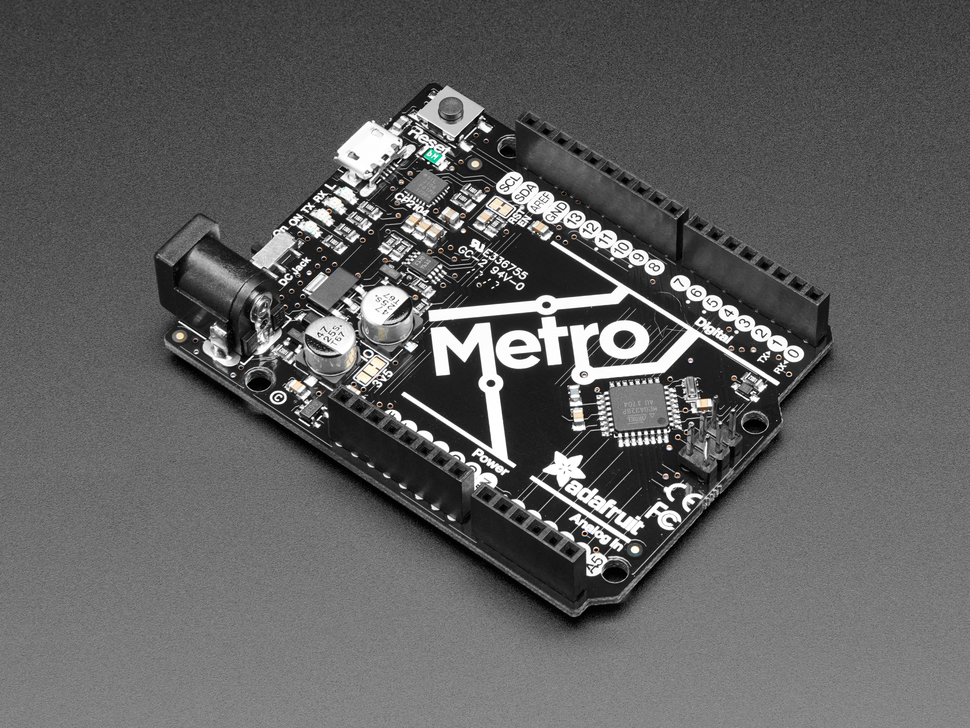
The Adafruit METRO 328 is a fully assembled Arduino-compatible development board based on the ATmega328P microcontroller running at 16 MHz. It ships with the Optiboot bootloader, making it immediately programmable via the Arduino IDE by selecting the "Arduino UNO" board target. Adafruit's implementation stays true to the Arduino UNO R3 reference design while adding their signature black PCB with gold-plated pads.
The board provides 20 digital I/O pins (6 PWM-capable), 6 analog inputs, and hardware UART/SPI/I2C interfaces. A 6-pin ICSP header is included for direct AVR programming. Connectivity comes via a micro USB port handled by the CP2104 USB-to-serial converter, plus a 2.1mm barrel jack with an on/off power switch accepting 7–9V DC.
Power regulation is handled by two onboard regulators: a 5V rail capable of 800mA peak and a 3.3V rail at 150mA. A solder jumper allows reconfiguring the logic level to 3.3V. Four indicator LEDs (power, RX, TX, and pin 13 status) provide instant visual feedback during development.
The METRO 328 is fully compatible with Adafruit's Classic and R3 shields and works with all standard Arduino libraries, making it an ideal drop-in replacement for the Arduino UNO in space-constrained or cost-sensitive projects.
Use Cases
4Prototyping
Rapid hardware prototyping and proof-of-concept development with breadboard-friendly form factors and accessible development environments.
Education
Teaching programming, electronics, and computer science concepts. Popular in schools, universities, and coding bootcamps.
IoT
Internet of Things applications including connected sensors, actuators, and smart devices that communicate over WiFi, BLE, LoRa, or other wireless protocols.
maker
Resources
Where to Buy
Explore more of the directory — popular use cases, firmware, and specs to browse next.