Adafruit Feather RP2040
Feather-form-factor board with Raspberry Pi RP2040 dual-core Cortex-M0+ @ 133MHz, 264KB SRAM, 8MB Flash, 21 GPIO, 4 ADC, 2 PIO peripherals, USB-C with UF2 bootloader, STEMMA QT, and LiPo charging. Runs CircuitPython and MicroPython.
$11.95
Tap any value to browse matching devices
Specifications
Certifications
Components
Bus Interfaces
GPIO Map
Overview
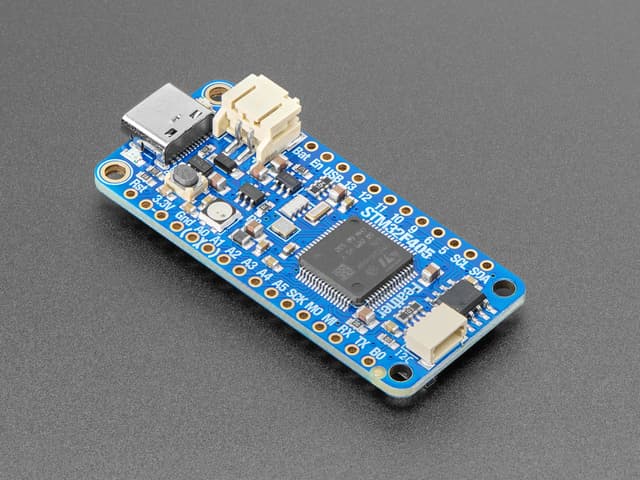
The Adafruit Feather RP2040 brings Raspberry Pi's first in-house microcontroller silicon to the Feather ecosystem. The RP2040 is a dual-core ARM Cortex-M0+ chip running at 133MHz with 264KB of on-chip SRAM organized in six independent banks, giving it an unusual advantage: multiple DMA channels can access different SRAM banks simultaneously without contention. The Feather RP2040 pairs this with 8MB of SPI Flash for program and file storage.
Two PIO (Programmable I/O) state machine peripherals — each with four independent state machines — are a defining RP2040 feature. PIO allows the chip to bit-bang custom serial protocols (WS2812, DVI video, I2S audio, custom sensor protocols) entirely in hardware without CPU intervention, at high clock rates. This significantly expands the board's peripheral capability beyond what the eight hardware PWM channels and two I2C/SPI/UART controllers would suggest.
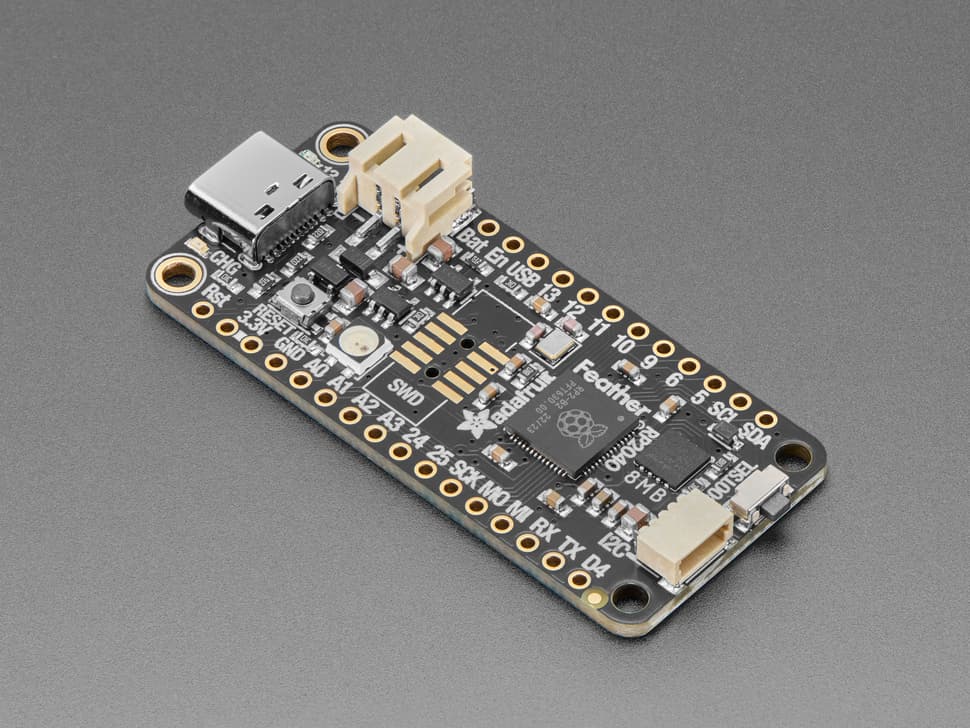
The Feather RP2040 follows Adafruit's standard Feather form factor: 51.0×23.0mm with the familiar pinout and LiPo battery connector. A USB-C connector provides power, programming, and data (with the UF2 ROM bootloader enabling drag-and-drop firmware updates). A STEMMA QT / Qwiic 4-pin JST-SH connector enables one-wire I2C sensor attachment. A 200mA+ LiPo charger and a 3.3V regulator with 500mA peak output complete the power system.
Twenty-one GPIO pins are exposed including four 12-bit ADC inputs and 16 PWM channels. All pins support I2C, SPI, and UART via flexible peripheral routing. The board ships with the UF2 ROM bootloader, CircuitPython firmware, and is fully supported by Adafruit's CircuitPython ecosystem and MicroPython.
Use Cases
4IoT
Internet of Things applications including connected sensors, actuators, and smart devices that communicate over WiFi, BLE, LoRa, or other wireless protocols.
Wearable
Body-worn computing devices including smartwatches, fitness bands, and health monitors.
Smart Home
Home automation devices for controlling lighting, climate, security, and appliances.
Music Player
Embedded audio player with speaker output, controls, and display for playing audio files or streaming.
Resources
Where to Buy
Explore more of the directory — popular use cases, firmware, and specs to browse next.